Of course I know this and always keep an eye on the market, but I trust readers to do more than they are often given credit for. Everything I’ve read so far that’s been created by LLMs is light years behind an author’s manuscript. Authors who use such services just to make a quick buck disqualify themselves in the medium term.
1 Like
Oh, I agree. But when LLM companies say they want to replace human authorship, it would be extremely foolish not to take them at their word.
Especially when the route to doing so necessarily involves incorporating vast quantities of human-written work into their training sets.
8 Likes
Of course, I don’t ignore this, but I believe that an author will always be superior to an LLM when it comes to creative writing. Above all, readers will realise who or what is behind the manuscript. I trust the readers.
1 Like
My view, fwiw, though I think it’s clear through observation, is that ML is very powerful in constrained contexts. e.g. chess, go, predictions of protein structure, x-ray analysis, and so on. Thus, in our context, it will likely be great for specialised tools. e.g. spelling and grammar checking – I mean grammar’s just a set of rules, right?  Ditto punctuation. You’ll have to pry my n-dashes away from my cold dead hands. Begone foul m-dashes and yourshuntedtogetherbehaviour.
For open contexts, such as writing a novel, or even a short story, ML is likely to be less successful, though it might be “fun” for rewrite-in-the-style-of type stuff. And it can certainly be helpful for generating ideas, which a writer can then insert or string together.
Self-driving vehicles is a good case of an open context. Where the environment is constrained – for example, a quarry or a warehouse – then ML can work well; on the open road… well, they’ve been trying for quite a while now and man those edge cases keep popping up and killing folk; and they always will unless the environment in which they operate is “prepared” in some way.
So yeah, great for tooling, less so for producing the whole kit and caboodle. I think we’ll have to wait to AGI for that.
1 Like
I agree with your statement. I have yet to read an AI-generated manuscript section where I didn’t immediately realise that it was generated by an LLM.
The day the first real AGI is generated, everything changes anyway and it’s not just the writers who need to be afraid of it, but all professionals.
However, I am convinced that it will be a long time before we reach this technical level.
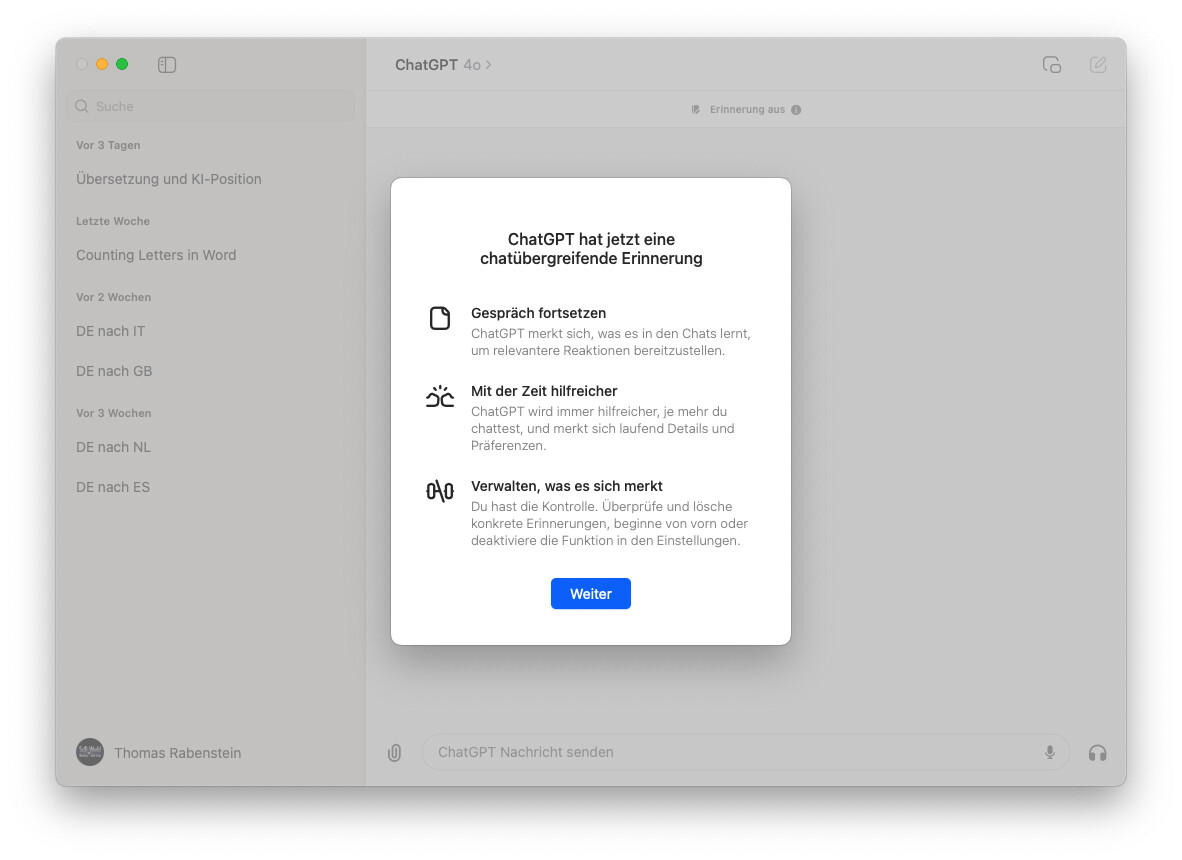
In the meantime, OpenAI has just announced that ChatGpt can now create cross-chat references.
This description from Grady Booch on Twitter today about LLMs is close to where my head is at.
He says:
LLMs do not think or reason.
LLMs interpolate within a high dimensional latent space. They are undeniably capable of generating remarkably coherent results (which is their strength) but do not in any sense of the word understand (which is their weakness). As such, they are inherently biased by the nature of their training corpus and when they attempt to extrapolate beyond their training, they tend to confabulate.
Human thinking and human understanding are not mere statistical processes as are LLMs and to assert that they are represents a profound misunderstanding of the exquisite uniqueness of human cognition. To paraphrase Sagan, the brain does much more than predict. It generates abstractions; it builds theories of the world, of others, and of itself; it has agency that is tempered by a complex interaction of its subjective experience, its goals, its desires, and its feelings.
I have reason to believe that the mind is computable, that sentience and sapience are beautiful consequences of the laws of physics. Someday, we may understand how to build a mind.
But this is not the day, and likely not even the generation.
LLMs are not the path. They are a small part of the journey.
6 Likes
Masterclass.com has a new class about using AI. In it, a prominent expert in ML/AI explains that what is called “hallucinating” is the way an LLM makes all its answers. It’s always hallucinating. Sometimes it’s just not as accurate with its probabilities.
1 Like
A fair number of Neuroscientists (myself included) think that human consciousness is also controlled hallucination.
As you allude to with probabilities, humans have metacognitive[1] tools to disentangle the probability space of our internally generated “reality”. This can temper the generative “hallucination” with existing knowledge to better comport with the external world (something that fails for people with schizophrenia for example)…
[1] metacognition is the ability to think about our thinking, to assign confidence to our decision making based on our experience and the sensory evidence and internally generated conclusions. Metacognition is a new but growing area of research for LLMs, so hold on to your hats…
To me, it’s a clear indicator that corps invested too much into LLMs, more like an “all-in”. Now, they urge to return on investments but they are not making that much profit as they hoped. So, they hammer AI-shit into EVERYTHING to be sure to get those money back.
1 Like
Been using scrivener for quite a few years now and still seeing it as the best out there.
And now there’s chatgpt. What a great tool it could be for uploading my million word trilogy-that’s-now-a-quintilogy, and having it answer questions like “when he picks up the gun in book 5, was it really loaded in book 1?”
I’ve gotten advice (from cpt itself) of exporting, splitting it into chunks and having questions answered about the chunks, but that will miss parts. I see I also this week have the option to build my own gpt and have it digest my novel. Even as a software guy, I want to look for a pre-built option.
Is anything out there? Do Scrivener folks have plans to integrate with the LLMs out there? What can/should I do here?
1 Like
The word limit for ChatGPT and similar tools is a function of the (large) hardware resources they need. The bigger the text being analyzed, the bigger the computational footprint. So that’s a function of their technology and outside of our control.
We do not discuss future product plans, but I can say that we expect to support Apple Intelligence once it’s released as part of Mac OS. Support for ChatGPT and other standalone chatbots is likely to resemble our support for bibliography software, in that we are unlikely to tie ourselves to any particular tool.
3 Likes
I read Seth’s Being You last year, and found it to fascinating, particularly the idea of controlled hallucination, which in his telling seems very plausible to this layman at least
I was interested enough to think about learning more about the various theories of consciousness to see how controlled hallucination fitted in. So much so that I bought Blackmore and Troscianko’s Consciousness: An Introduction, which is now sitting hugely and happily about half way down the Reading Pile of Doom. One day…
1 Like
So, CoPilot for the Windows version?
You could of course try Sudowrite, Novelcrafter, or RaptorWrite, which keeps you a Writer, and not a Prompt Engineer.
Does this answer your question. The bloody thing is everywhere, watching, waiting, reading, intruding—even on non-Co-Pilot PCs. 
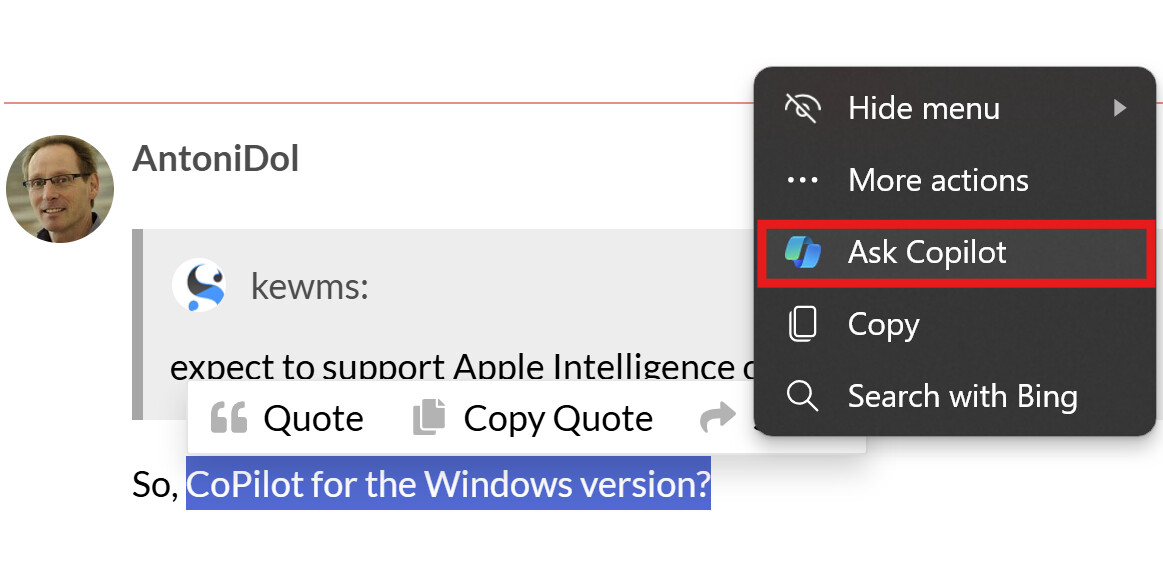
The end is nigh, I tell you, the end is nigh!
2 Likes
“A gentle reminder that Literature & Latte is not, and has never been, a democracy. Scrivener was created because Keith was unable to find software that worked the way he wanted to, so he wrote his own.”
You market the software to others, therefore you have to accept that others will want to make suggestions. But you appear resistant when customers make suggestions.
“and we wish all writers success no matter what tools they choose.”
In other words - sod off.
This forum is the embodiment of acceptance. Everyone can make suggestions all day long. Even the same ones over and over and over again.
In other words: Competition. Product A doesn’t meet your requirements, but Product B does? Great. Buy Product B. Problem solved!
7 Likes
Not all suggestions are possible to implement. Not all suggestions are even desirable to implement. This is true of every software, on every platform, from every company. By “resistant to suggestions” you appear to mean “willing to admit something that is painfully obvious.”
5 Likes
And now, I return to the idea of thinking that I am not thinking, I’m just an agreeable group of mirrors.
I’d like to see some non-generative uses, like for a world bible, particularly the ability to access it and use it across a series. The character and setting templates are nice, but not robust enough. I’d like to select a block of text (that I’ve written, to be clear) and then have the option to add it to a particular entry in a world bible. Right now I use a comment like “Description of House sigil” but inevitable when I search for it I can’t remember quite how I phrased the comment. You gotta know what to search for and months (or even days later) that datum is gone from my brain. It would be nice to chat with the bible entry too and ask it to check the lore for let’s say how the nanites in my world work at this point, i.e. for it to know that at this point we only know x and y, but not z which comes later. I have over 500,000 over a trilogy with extensive world building and having to put the bible elsewhere is a chore when it comes to maintaining data integrity (since I have to remember to update things in more than one place, i.e. the manuscript, and wherever the bible resides). It would be sooooo much better to just have it all in one place. Yes, Scrivener is a great writing tool and like any specialized tool, it’s at it’s best when it focuses on one thing, but I can’t be the only one who needs a better way to build and maintain a bible.
1 Like