There isn’t one. The very fact that the livelihood of some nice people depends on it is kind of reassuring.
3 Likes
The main reason for pirating was the cost of the pirated software, but if you remove the exorbitant cost most people are willing to pay.
4 Likes
You make excellent points, but the fact remains that authors can spin up a writing app in an hour or two with the precise features we want. Not only that, we can taylor it to a particular writing project. If L. Frank Baum (the Wizard of Oz author, of course) were alive today, this is what he might have created in order to keep track of all of the elements of his fantasy novel series:
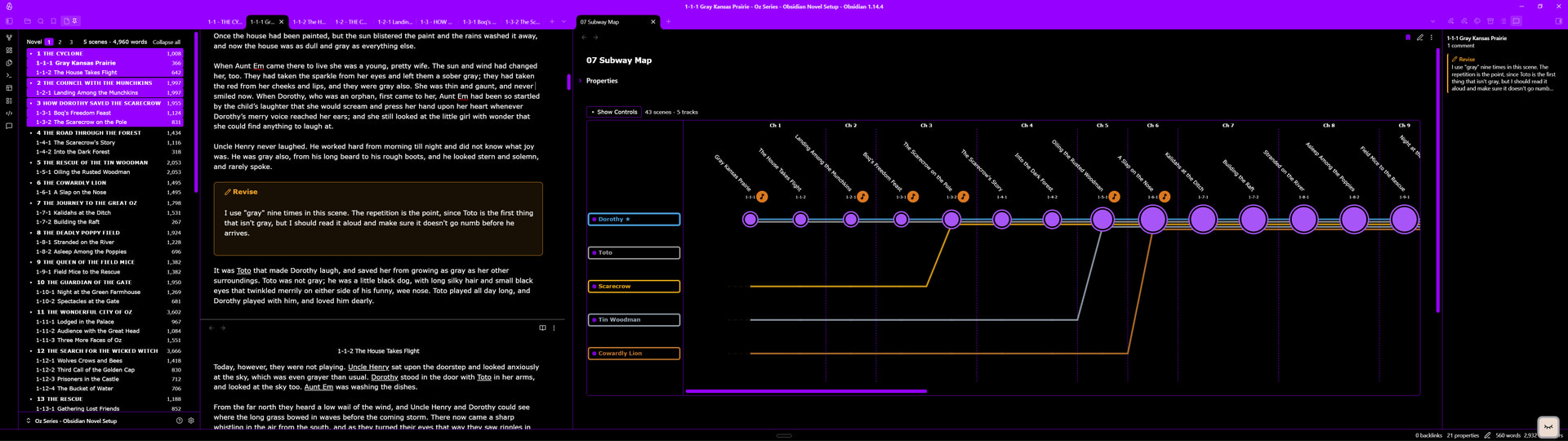
And this is only a fraction of what this app can do.
I did code a lot of what you see, but used Claude to help me when I either had to spend a lot of time improving my skills in the case of building the Subway view or use Claude to take me over the finish line so I could get on with writing my novel series (where no AI will ever go).
I’m not smart enough to predict where all this is going, but it would be a mistake to underestimate just how good AI is getting in spinning up apps or extending them. I don’t like it, but it is true, nevertheless.
P.S. Mr. Baum would have an ultra-wide monitor and a penchant for purple, no doubt. One can’t have too much purple. 
How do you make sure that it doesn’t create or extend them in a way you didn’t anticipate? Genuine question.
1 Like
Whilst I love and admire the purple, I am slightly disturbed than NONE of your brick roads are yellow. 
5 Likes
You are so right. There is nothing like tackling a big coding project. (My first such project was hand-coding the HTML of my first web site on a server I set up in my home. I wrote a couple of PERL scripts to make stuff work. That was before the first HTML editors became available. Dang, I just might be an old-timer now.)
My challenge right now is writing my novel series and composing its score. I’ve been at it five years now since, obviously, I’m not using AI for my writing because for me, it’s all about human artistic creation and the journey. I didn’t really enjoy using Claude to help me with bits and pieces of coding the extended functions of my writing app, but it was either that or face too many days of lost time I could have spent writing my story or composing the music. So I traded the satisfaction of working for hours and hours through the remaining coding problems myself for the eventual immense satisfaction of writing and composing for my novel.
For those who think of their software projects as their creative endeavor (and I was one back in the day!), turning to AI would take that away from them. It replaces us with a machine. It’s a nightmare, really.
I recently wrote a book teaching nonprofit/NGO fundraisers how to work with AI at their side, the premise being to never, ever let it push them from the chair. This kind of human battle with AI is everywhere. And don’t get me started with what it’s doing to novelists and composers.
I have a bad cold and my brain is mushy. Sorry to run on and on like this. Back to bed now…
1 Like
Oh, I should add this. If anyone here is fundraising for an NGO or nonprofit organization, consider signing on to our open letter: https://charitychannel.com. It seeks to put an end to the alarming and growing practice of having AI agents communicate directly with donors without so much as a review by a human, essentially pushing human fundraising professionals out of their chair. I call this empty-chair fundraising, and left unchecked, it’s going to destroy the trust of the public in charitable/philanthropy organizations and institutions.
Now I really am climbing back into bed. I think I have flop sweat…
You’re contradicting yourself here. Most writers do not have your level of expertise and don’t want to develop it.
4 Likes
Not really. Reverse engineer all you want, to be able to replicate the functionality 100% is hell of a lot harder than using existing, already working and proven application and adding features to it. Even converting it from language A to language B is way easier when you have the code that you can use to compare your conversion to that rather than trying to use clean room to do it. You only need equivalent OSS applications to do that - not dozens - and there are only a few that are in feature parity - or exceeding Adobe’s offering. Gimp, Scribus, Inkscape, Blender, Shotcut and LibreOffice Draw are all you need.
If this is a revenge project, fair enough, otherwise it’s just waste time to produce subpar product just because you can.
Feel sorry for you Keith. The potential for years of hard work being copied and tweaked by some pimple faced AH using AI and then profited at your expense.
Happy to join you on some loom smashing.
Mind you, just thinking back to all the 2am mornings writing the importing, distribution and accounting app for the very first Mac, the broken marriage and all the Friday and Saturday nights I wasn’t available for dating…
I could have been partying and just a quick ‘vibe’ session as the hangover wore off.
5 Likes
@piivonen “Built from nothing” sounds way cooler than “modified some existing open source projects”.
Of course, this “nothing” is based on a lot of “borrowed” training code. (Likely including all of those projects you mentioned.) So the room wasn’t clean to begin with. Just free of Adobe code, or reverse-engineered code from Adobe binaries, for that matter. You know what I mean.
It’s confusing if you keep looking at it as a “good faith” project. Yes, it’s open source, but they also heavily monetize it. “Max” tier at $48/mo, and “Enterprise” is probably more expensive than Adobe, I assume, otherwise: What’s the point of hiding it?
Gets even funnier when you visit the storyteller(dot)ai site. Doesn’t take much time to find jewels like “NEW ArtCraft · by the FakeYou Team”. If that doesn’t cause you to instinctively reach for your credit card, I don’t know what else it takes.
It’s not a good vs. evil story. It’s an evil vs. evil story. That’s the entertaining part.
6 Likes
Isn’t that an hour or two the author could’ve spent writing her actual book?
8 Likes
By reading and watching at the first tests, it looks like the UI was borrowed by the Adobe apps, but the actual routines from the open source ones available to the AI tools. The software behave on the surface like the Adobe equivalents, but image filters, text manipulation and the like are different.
Is it just because they are early alphas, or is this expected with vibe coding?
Paolo
2 Likes
It’s WYSIWYG (What You Say Is What You Get). So you need to be very careful what you say, or rather very specific. If you don’t know what you’re talking about – the machine doesn’t, either.
2 Likes
If that’s the case, then the reverse engineering part makes even less sense. You can clone UI by looking at the real thing, promotional pictures, reading the manual or taking screenshots. You don’t need to “reverse engineer” anything to clone the user interface.
Neither you need to reverse engineer the features, you know what the software does by reading the manual and/ or using it.
The only reason to reverse engineer is to find out how something is written and how the internals work to either clone it or inspect it for other reasons, not for building features or UI.
Either they are really, really dumb or this is a marketing trick.
4 Likes
Based on @ptram ‘s observations, these “reverse engineered Adobe clones” aren’t even that. If those observations are correct, this whole thing makes even less sense. I can think of couple scenarios of what may be going on:
- These guys are really dumb and actually went through all that reverse engineering trouble and don’t even understand that AI is using OSS code for rewrites
- They are baiting Adobe to take legal action safe in the knowledge that there is nothing even remotely illegal in what they are doing (because they are using OSS code)
- This is a marketing campaign - they are hoping the story goes viral and brings in new customers
1 Like
Trying to figure out how to navigate a world with AI is often confounding. I’m not surprised if I am contradicting myself. I’ll take your word for it that I did; it wouldn’t be the first time, if so, when writing about AI (though hopefully my recent book on AI and fundraising is at least internally consistent).
I’m not sure who injected “reverse engineering” into this thread, but it certainly contradicts the “clean room” claim. The question I personally find much more interesting: If really dumb guys can do this with little effort in a short period of time – what happens when the smart ones…
Doesn’t mean they can’t get in trouble for distributing a 1:1 clone with a different name / logo that otherwise looks and behaves exactly like the original. E.g. all the icons (other than system UI elements or free assets used by Adobe) are copyrighted. Not even touching the patents topic.
120% this.
1 Like
This is a classic example of Clayton Christensen’s theory of Disruptive Innovation. It happens in every industry – someone figures out a way to do something better and cheaper, and it either takes over or disappears.
As authors (should) well know, you can’t copyright an idea, only its expression. The same is true of any other intellectual property including software.
Business evolves. Society evolves. Even bacteria and viruses evolve.
AI-assisted black box reverse engineering is currently disrupting Adobe and probably other big, expensive software suites. Everything Adobe makes disrupted earlier technologies, putting their developers out of business.
Also, there have been open source versions of all of Adobe’s applications for decades. And Adobe’s not the only company whose products have free open source equivlents.
Even entire operating systems have been replicated by open source – Linux is an excellent example of this, and has survived relentless attacks by the zombified remains of SCO which still rises from the dead occasionally to attempt another trollish filing.
If these new applications exactly replicate the look and feel of the user interface, Adobe might be able to claim IP infringement. As for the actual code, they’d need to prove that these AI agents somehow incorporated actual Adobe source code into their work.
Adobe’s business model, like virtually all business models, is destined for obsolesence and failure because peoples’ natural creativity keep finding find better ways to do things. Business evolves. Society evolves. Even bacteria and viruses evolve.
Incidentally I don’t get a strong sense that Scrivener is in any immediate danger of being cloned by AI.
3 Likes
1 Like