Sure, I agree. I was just trying to make a case for an integration that might actually be valuable as opposed to plugging in an LLM to generate/edit documents. Scrivener isn’t alone in this, but any tool with a 700+ page manual (not including appendices) needs an agent between it and the tool’s mechanics.
The IBM manuals for the 5160 (PC XT) came in at a whopping 1,046 pages (Guide to Operations @ 364 pages + Technical Reference @ 682 pages). That was in 1983 (last revised ’84).
How come that users 43 years ago – many of them touching a computer for the first time in their life – could handle a thousand pages of manual, and somehow four decades later this ability got lost?
How did they survive this, only equipped with a pair of eyes and a wet finger. No smartphone to search, no video tutorials to watch, no forum to ask (all of that for free!). It’s a miracle.
4 Likes
FWIW, using an AI to “talk” to a large document is a pretty common use case and doesn’t require anything special on our side.
2 Likes
Since the slim manual for the first Macintosh was a major part of its appeal, the extent to which users “could handle” the PC manual is debatable.
1 Like
IBM still shipped way more units (even at a considerably higher price originally, if you factor in the additional cost for a display). The manual probably had little to do with it.
Although I have to admit: If you sell a product that requires less to no manual, that’s nice. Of course it is.
Not what I was implying at all, but I suppose you could make the same argument about writing by hand. Or replicating text without printers. Can we still do it? Yes. Is there a better way? Also yes.
It is and it works. What I dream more of is: “Here’s what I want this project to look like. Apply X font, set up indentation, split the thing into four parts, give me 10 chapters per part, and 3 scenes per chapter.” And then I can go make coffee while it does the soul-sucking part of setting up a project/changing a template.
It seems to me that assigning scene breaks and chapter breaks to existing text is a writing task. If you’re talking about setting up a template for a new novel, here’s one that meets your specifications. It took eight minutes, including the time to type this message. And now that the template exists you can use it as many times as you like.
(I started with the supplied Novel with Parts template and just duplicated files to get the desired number. I didn’t set up the font or indents because you didn’t say what you wanted. That would be another two minutes with the Project → Formatting pane.)
Novel (with 4 Parts).scrivtemplate (461.9 KB)
3 Likes
Not sure if this is a fitting simile. (Some people would even argue that writing by hand is the better way. Not me, though.  )
)
The manual contains no useless information. Letting someone or something else read and summarize it means you’re missing out on a lot of details that this helper deems unnecessary. Best case scenario: You end up with a solution and have no idea why it works. Not an effective way of retaining knowledge (the only thing that actually saves you time in the long run).
4 Likes
Meh. I’d rather not have AI “pollute” the app. It’s about writing, and doing your own writing. If you want to edit your texts, external LLMs are always at our disposal. But I wouldn’t want to see it incorporated into Scrivener, at least for now. A conservative approach would be best here, in my view.
4 Likes
A well crafted duty to the reader backed up by business writing skills all but forgotten in this day and age. Indexes and appendices too.
Though I think the biggest difference was that the people that used those old computers wer technically minded and not afraid to learn the foundations they needed to, when most everyone else couldn’t be bothered to set the clocks on their VCRs no matter how annoying that flashing 12:00 was on the front display.
These days those same 12:00 muggles are the ones using all of the computers and wanting AI to do the foundation work for them.
EDIT: Not throwing shade at anyone here. I’m simply remarking about an observation fifty-mumble years in the making.
6 Likes
Thanks, that was really going out of your way! I was just illustrating an example, but maybe someone will find this template useful. Incidentally, ~8 minutes is the time it takes me to brew coffee, so let me know where I can buy you one 
Not really, which was kind of my point.
3 Likes
There isn’t a point to gate-keep AI. In the end, people will decide for themselves how much AI they want to use, and they will find a way. An application is more useful when it provides users the ability to choose the use of a particular feature. Something that’s AI friendly will be indispensable to some.
Will some people create slop with AI? Yes.
Will some people create slop without AI? Yes.
Using AI doesn’t automatically make it slop, it’s the person behind it.
Using AI is its own skill, and people are already figuring out how to use it in a way that best suits their need. This is a change to how people work and it has parallels to the wide distribution of televisions, the industrial revolution, and other similar significant changes to society. This isn’t just a “young person” thing.
Integrating directly with ChatGPT, Claude, or anything else, isn’t the right way to go IMHO. I think it’d be a waste of time and effort, at least for now. Instead, allow for a much easier integration. Have native support for markdown files. i.e., allow people to add markdown files directly to a project, and have them remain markdown files so they can be accessed externally and internally.
1 Like
This is absolutely in the crosshairs of Sturgeon’s Law. The thing is, I think when it comes to AI slop, Corporate Enshittifacation, and co-mingling of so much stolen effort from writers that went through the winnowing process for publication that the users of AI never have[1]… That there might just be a need to update the old ratios and terms.
Where Sturgeon postulated that 95% of EVERYTHING is crap, I think its closer to 99.9% (with social media excluded in total, add around four nines to that figure if you want the Farcebook slop too).
Thing is, slop isn’t new. Writers last century, writing for scale and on deadlines, often only needed to be right long enough for the “all the news that’s fit for bird cage liners” to be run off the presses and sent out into the world. Any really objective study of the newspaper industry from the end of the US Civil War through the cease-fire that ended overt hostilities in Korea will see this. And that doesn’t even get into the wave of ever more sensational ‘journalists’ shoving microphones and cameras in emotionally wrecked people’s faces in the pre-internet era. “If it bleeds, it leads” is as cynical a epitaph of journalism in the 1980’s and 1990’s, but it was as accurate as I’ve ever seen a stereotype with my own eyes.
If you check the footnote above, I reference the Sad Puppies to make a point. I’ll close by reframing that point: The mind behind the tool matters. Only in this case, we don’t know who the mind is, if it is silicone or carbon based, but we do know we are the tools, slop is just the excrement that is left behind.
This is one reason why there were so many square jawed, blonde, blue eyed, buff hero in pulp. The people paying for the art wanted those stories. The Sad Puppies movement was similar in effect if not different in targets or motivations. When the masses at the gates find out they can bypass all of the standards, you get slop. Worse, the AI models – on seeing some movement on the slop – conflate views with acceptance/popularity and then they further weight the trend, only for other LLM crawlers to find the new stuff to scrape and next thing you know, there is a circular logic trap keeping slop on the top, with no clear way to escape from it. ↩︎
2 Likes
I disagree. LLMs, by their very design, construct “average” prose. They are, by design, incapable of originality. They do not have even the beginnings of true “understanding” of their output, they simply burn enormous amounts of energy to find the most likely response to their prompt.
The raw output of an LLM prompt is always going to be slop, because they are incapable of anything else.
7 Likes
I like AI because I have a poor memory. When working on multiple chapters at the same time in Scrivener, I often end up creating fifty or sixty index cards for every chapter. This leads to inconsistencies and repetitions in the information I’ve recorded. It would be extremely helpful if AI could help me review these index cards, suggest improvements, and organize them automatically with my permission.
But I can’t possibly let AI write the actual text.
I actually agree that, in some contexts, AI can be a good study aid. I’m dyslexic, and these tools (and adjacent tools) are an important part of my work & creative life. However, I increasingly find trying to balance the “this is useful” with the actual cost (moral, environmental) is really pretty hard. And NEVER for actual prose.
2 Likes
I think we, probably, all agree here. I haven’t seen anyone here, so far as I can tell, say that AI should be writing anything. There’s no question that some people use AI to write the story, or even parts of it, instead of writing it themselves. To me that’s a mistake, but that’s their decision… and frankly, I don’t care either way. There’s no point in worrying about it. There are other ways to use AI.
The whole discussion of AI good/bad isn’t the reason for this request. The purpose of this request is for the next editor to be more friendly towards using another software tool that some people are already using, and will continue to use. AI a tool. It can be used in a way that’s beneficial and destructive.
My request is for the editor have built-in markdown support. There is nothing wrong with supporting an additional file format. Supporting markdown as an additional document type that can appear in a project doesn’t force using AI. It’s a feature with benefits that even go beyond the single use case of allowing easier AI integration, but the AI use case is why I’m requesting it.
I really doubt @KB will add two different rendering engines to the editor, that is a lot of extra complexity as the whole of Scrivener is built on Apple’s RTF-based engine, this would impact huge parts of UI, the compiler, disable tools like revisions, snapshots and lead to a mess of a UI as menus en/disable for differrent binder docs). You can already just write plain markdown in a scrivener doc as you want and automate from that? BUT for example to keep using RTF in the editor how about a “Copy As Markdown” option, this would take a selection and do a basic export to the clipboard. You could automate this with applescript so it would get content out to an agent make edits and come back in (as markdown, so probably you would need to convert back to RTF with applescript). Scrivener keeps intact and this facilitates it plugging in to other tools wherre markdown is now dominant). You can alreadt export/compile but this does add some manual steps that are more klunky to automate, so “Copy as…” would be a simpler addition…
EDIT: ha I’m an idiot (and/or @KB thought of everything), that option already exists in the Copy Special sub-menu which I didn’t look at for some time:
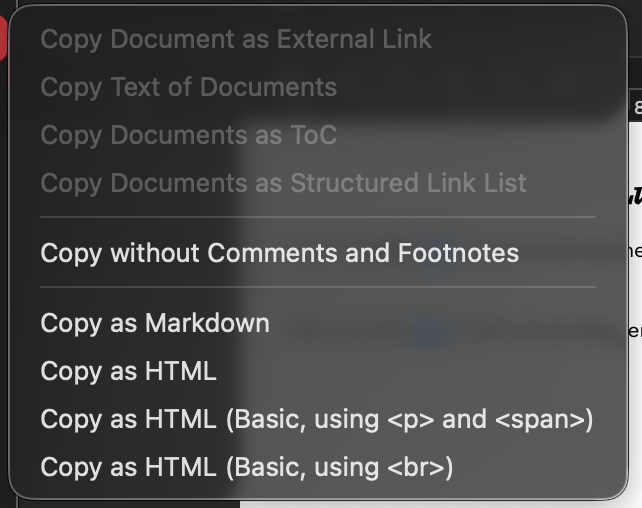
So the problem is really just the round trip, pasting markdown text and getting it back to RTF that can be done by pandoc etc – so with BTT or Alfred we can take a Scrivener selection, copy as markdown, send it to an LLM, get markdown back, convert it RTF and paste it…
2 Likes
Yeah, there’s more than one way around this. I prefer taking the approach with the least amount of steps. Maybe Markdown doesn’t have to be supported, just be able to add access to a simple text file – not sure I like that idea myself, all of these are just bandages over the core problem.
Much like when we went from calculators to spreadsheets, there is a new way of doing things. The tools that streamline those things are the ones that will succeed.
In the end, I’m looking for a streamlined solution.
1 Like