Chess computers beat the world’s best human players decades ago. Yet people still play chess.
Mediocre writers are the ones who will suffer. Why pay a mediocre writer when an AI will do the job for free and much faster?
AI only “knows” what it is trained on. It can read and write descriptions of, say, first love, but it will never experience it, much less your experience of it. You can look at the world with fresh eyes, something an AI will never have.
That’s an important insight….the human experience is what makes the IP into IP. Would that give the individual who is good at the core idea, but poor at the execution a better chance? I’m guessing that there will be an eventual separation between the original thought (and splendid prompt from the human) and the labor of creating 80,000 words (the machine’s role). We may actually be there already, for all I know. Publishers may be paying their stable of writers for core ideas already, then turning AI loose on them. Titles can be churned out overnight…even variations.
CLUE comes to life: In this title it was “the mayor, in the Council Chambers, with the letter opener. But, in this other title, it was ‘the bombardier, in the hanger, with the fuel strainer.”
Does the value perhaps move to the prompt, and away from the typing? And, does that level the field somewhat for the incredibly poor writer who has extremely good core ideas?
And what of the ‘wannabe’ writer who has great core ideas, but zero interest or time to execute the 80,000 words? Or the good idea that is only half done? The ‘shelf idea’? Do they suddenly have a lane to play in?
A question that runs through my mind for the writer who writes in hope of income, and who doesn’t fall in love with his/her stories: If you could write that splendid, perfect prompt in a day or two, would you part with the rights to it forever, for…let’s say…$2000 today? $3500 today? How many of those could you create in a month? How does that compare with months of writing, in hopes of snagging a book deal? it feels like minimizing risk and gaining rather quick feedback, as well as gaining agility to write prompts about what is trending, rather than finding out at the end of two years that I’ve completed a manuscript in a genre that is no longer very popular. I’ve also gained the ability to address my skills to what is current, and perhaps be ahead of the pack, so to speak. True, it may be a fraction of the ultimate value, but cash flow is a good thing, as is the return on my hours of investment.
All of this rumbles through my head. I’m pretty sure it’s the blood pressure Rx. But, I ask myself these very same questions about that OneNote file that I maintain with “Wacky Ideas That Might Be Worth Something Someday.”
The real question is if we respect ourselves and the craft. It’s the difference between climbing the mountain or flying to the top on a helicopter. Both can get us to the top, but only one gives us the satisfaction of real accomplishment.
There’s just nothing that compares with writing those final words: “The End” But, I do have a couple of ‘shelf titles’ where I would convey that right to someone else.
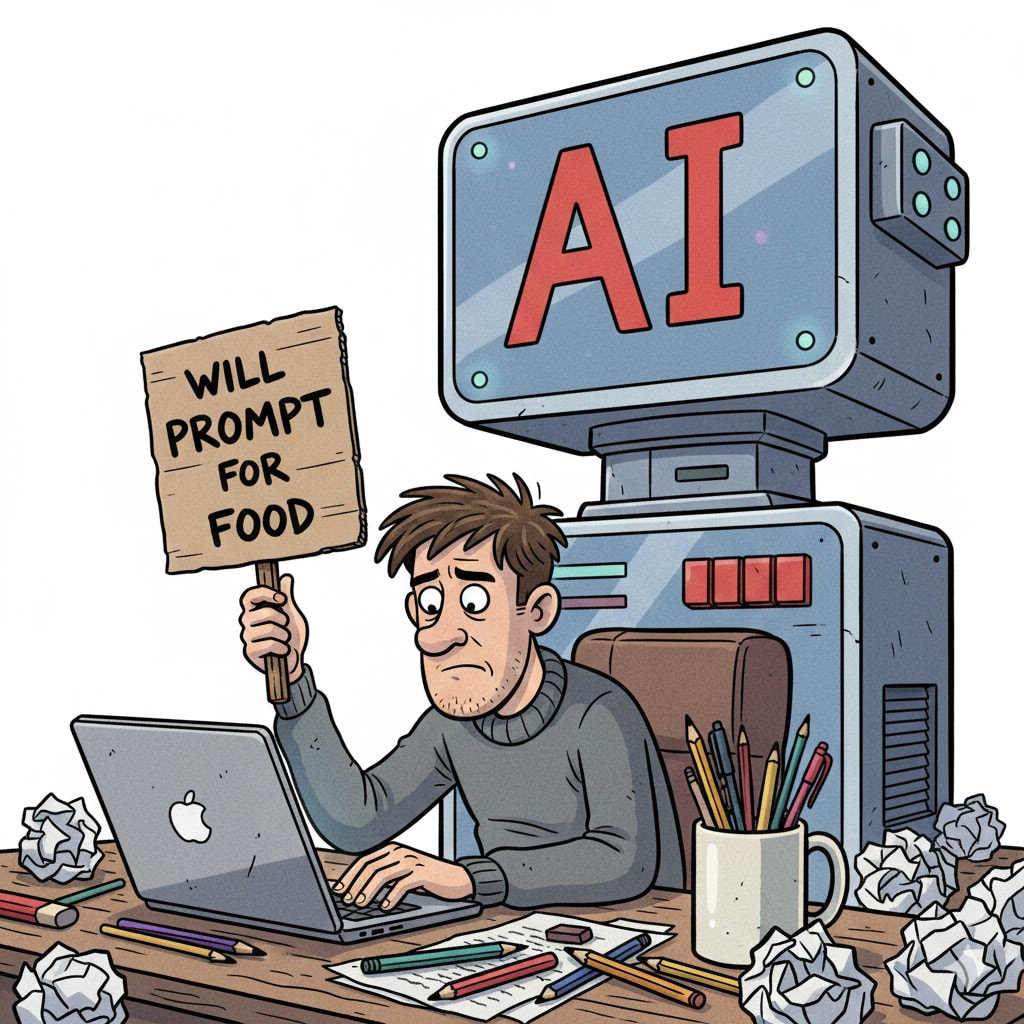
Oh, I just thought of a cartoon for writers. Too bad I’m not an illustrator: WILL PROMPT FOR FOOD
Many of the arguments above also apply to art. How much real physical resource was used to generate this illustration? Who’s art-style is this copying? What was it trained on? Would you use AI to generate a book cover?
Priceless questions. We are much on the same page. What a brave new world we are entering. Copyright law is enormously slow to evolve. The machines will be well ahead of legislation, but will no doubt force it.
The fundamental fallacy is to believe that “great core ideas” are sufficient. A piece of writing is not one idea, it is (depending on length) dozens, hundreds, even thousands. If you think that, given the “core idea,” creating 80,000 words is merely “labor,” you are not a writer, and feeding your “idea” to AI won’t make you one.
I might quibble with you there. Writers get little enough as it is. It’s the cost of editing and overhead that is a more likely target, is it not? Of course, if writers are dispensed with altogether…
The stated goal of the AI salesmen is to replace the entire creative team. I think they’re delusional, but that’s the goal.
In any case, I’m pretty sure no part of that vision includes paying $2000 for a prompt, much less enough to keep a “prompt engineer” out of their parent’s basement.
Yeah, they’re asymptotic. I mentioned this a few months ago. Basically:
Neural nets [which include LLMs] are functions of universal approximation. Very broadly, that means that to get arbitrarily close to the function being modelled, the number of neurons in the net tends to infinity.
…a statement which looks like a veiled advertisement for an alternative place to waste billions amongst billionaires. Stop pouring money into that person’s SillyThing, pour it into my SillyThing2 over here!
Not that I disagree entirely, I’d just stop at the “Stop pouring money into that person’s SillyThing.”
I understand the dislike of many of the characters in the “AI” space, but I’d not lump Demis in with them. The work he’s doing, and has done, is far distant from the likes of Elon and Zuck. And I don’t believe for a moment that he’s wanting for funds.
In addition, I presume you know Gary Marcus and his bona fides, so I’m surprised at your dismissal of the point he’s making. It’s a point many of us with – in particular – mathematical backgrounds have been making about LLMs for some time. If you haven’t read the article of his own that he links to, I’d highly recommend it as an overview of his point.
My disappointment is that Demis didn’t pipe up earlier.
You’re taking the joke a bit out of scope, especially if you’re applying it to the writer of the blog post as well. The only jab being made here is that CEOs are going to lampoon each other’s stuff and they usually have a good reason to do so that has little do with being right or wrong. To me, that is not very interesting; the second link is much more so.
As for the failures of LLMs, I’ve been pointing out those same problems and limitations for years. You don’t even need to understand how they work beyond a fairly surface level to see that simulating language is a dead end if the intent is to simulate knowledge, let alone any more than that. That is why none of this particular strain of technology has been of interest to me, especially given the enormous costs, and from a legal standpoint, the dubious data acquisitions it took to demonstrate the point.
I certainly don’t claim to be an expert, even at the level of commentary, or to have anything more insightful to add to the conversation than a joke, but it seems to me that anyone spending a few minutes with a chat bot should quickly see how wasteful that entire endeavour is; the holes start popping up very quickly. As a minor component in larger strategy, sure, but as the beginning and the end as some treat it, it is confusing the shadows on the wall for everything.
My collaborator recently had to attend a couple of lectures on the use of AI in teaching.
One example demonstrated was its use to correct oral language assignments (my collaborator teaches interpreting). The speaker played an example where AI was used to transcribe the students speech and then suggest corrections. The only problem was the transcription was full of errors and the corrections were then being applied to that faulty transcription, not to what the student had actually said. The response from the person giving the lecture was apparently that that was of no great consequence, what mattered was encouraging the students to speak!
 But, I ask myself these very same questions about that OneNote file that I maintain with “Wacky Ideas That Might Be Worth Something Someday.”