Thank you AmberV,
I understand your interest here were my perception true. Still, I appreciate the effort you put into this and my Idiosyncracies.
– While I have from time to time brought the footnotes from the Inspector to inline, such times are ad hoc, immediately reversed once dealt with: my overwhelmingly usual mode of fn use is in the Inspector, even to working in the note while it is in the Inspector view.
– Yes, “Terminate footnotes …” was ticked in Options > Editing > Options. However, I am familiar with the tick-box and did think I’d de-ticked it long ago. But, did I? (As you’ll see, regardless, how I’ve been doing things, in practice, it “hides” the ticked Termination consequence.)
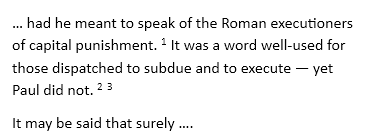
For my sample sentence, I have three fns after its period. Here is the text involved, from a pre-update snapshot (2 weeks ago):
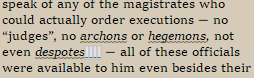
And here’s the text after the update:

Restarting Scrivener after the de-ticking, I executed the Insert > Footnote after another, test, sentence’s period. While the fn gets visually hung on the last word of the sentence, the fn marker does land after the period. (Sometimes, the hanging is from the punctuation and the immediately prior closing parenthesis, short of the last word.)
This is fine, but for two reasons tied to my drafting practice: I cannot easily move individual fns around, nor can I have more than one fn at the end of sentence; repeated “insertions” overwrites the prior text already in the fn unless I hang them separately; no second fn is acceptable. (Among other things, I don’t generally put fns mid-sentence, so sometimes, they accumulate.)
In the post-update sample image, the first of the three fns was hung from that last word, and the other two were post-update hung individually from the programmatically written "(Linked Footnote)"s, in reaction to there being no prior “word” … far more intrusive as I go through the text than the hard-spaces.
Due both reasons, I hang each fn from its own hard-space after the period.
Re “oddly”: yes, you got it right in your project, as far as I said it. However, for my purposes, I do put a space after the hard-space. Thus,
Re active and passive editor panes after the update, a similar view as earlier across the panes. (The active pane’s on the left in this project.)

(The fn’s after “her predecessors.”)
Re preupdate version: 3.1.5.1.
Every time I read this for content and flow, I tweak something: I’ll stop now, and REPLY.
PS: Here’s a curiosity. Sometimes, there was a fn immediately followed by a comment (also hard-space hung): When the fn moved to the last word, the comment was left as it was, beyond the fn’s hard-space and on its own hard-space, no “(Linked footnote)” rearrangement.
–