Adding AI tools to Scrivener

The Anthropic case was in District Court, which does not establish a precedent that’s binding on other courts. IIRC, at least one has already ruled otherwise.

“Simply pass a law” is not something that the AI companies themselves can do. They would need to persuade a government entity to do it for them. Given the current US government, I don’t think “buy a change in the law” is an inaccurate description of the process.

And of course other countries have governments too, which may reach other conclusions. Especially if they feel the dominance of the industry by US companies threatens their national security.

As for the future growth of AI, the companies in question are not currently profitable and have no clear path to profitability. I expect the money to run out first.

3 Likes

In keeping with the spirit of this thread’s title, I propose a “random odd sentence generator” be added; it can go right below the Name Generator.

8 Likes

Je think que this could être a very bonne idea.

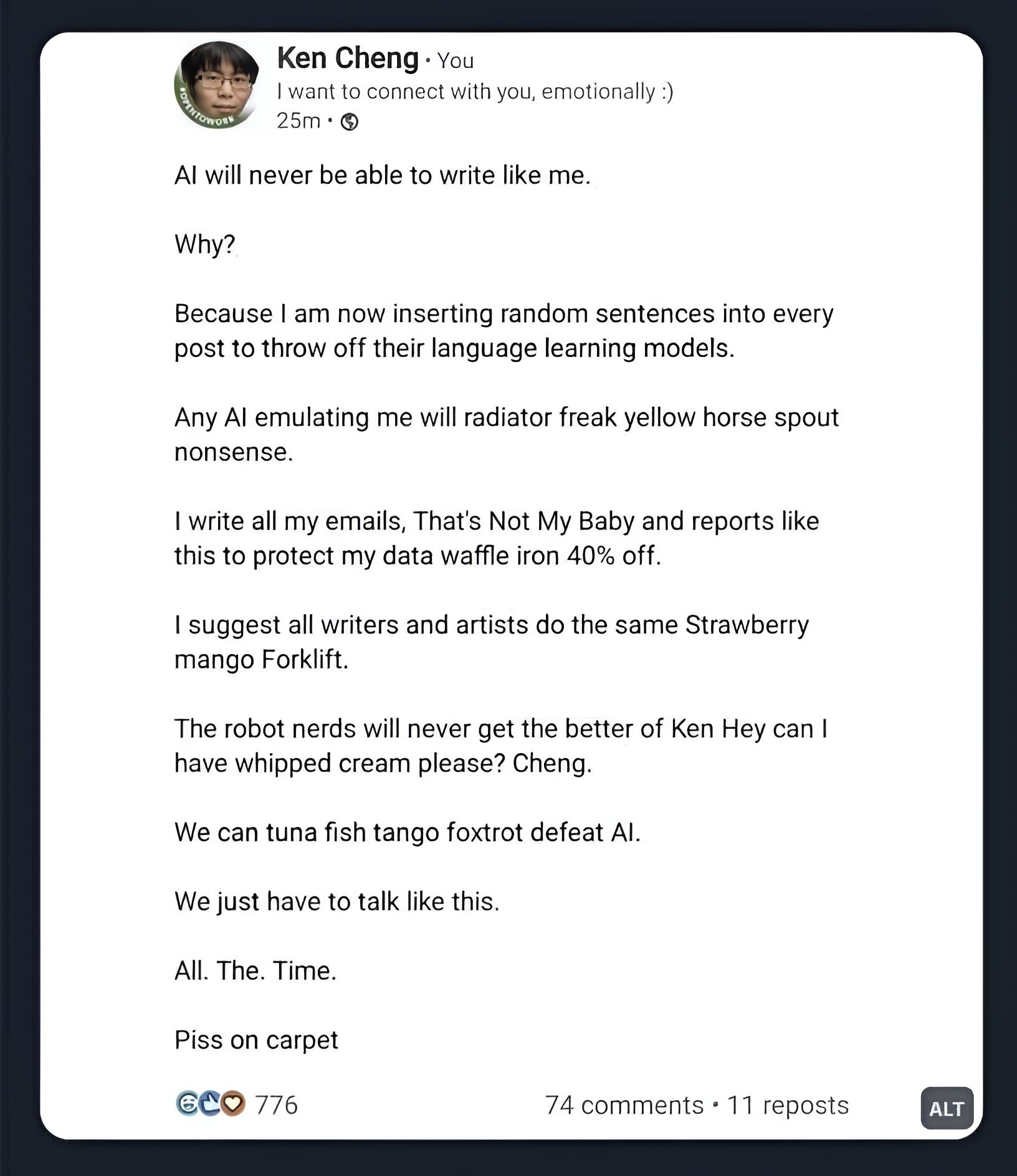
Butofcourseithastobereadablebyhumanstoo.

Donkey cowbell.

8 Likes

I don’t think we need to make things up when we could simply restrict AI training to James Joyce:

riverrun, past Eve and Adam’s, from swerve of shore to bend
of bay, brings us by a commodius vicus of recirculation back to
Howth Castle and Environs.
Sir Tristram, violer d’amores, fr’over the short sea, had passen-
core rearrived from North Armorica on this side the scraggy
isthmus of Europe Minor to wielderfight his penisolate war: nor
had topsawyer’s rocks by the stream Oconee exaggerated themselse
to Laurens County’s gorgios while they went doublin their mumper
all the time: nor avoice from afire bellowsed mishe mishe to
tauftauf thuartpeatrick: not yet, though venissoon after, had a
kidscad buttended a bland old isaac: not yet, though all’s fair in
vanessy, were sosie sesthers wroth with twone nathandjoe. Rot a
peck of pa’s malt had Jhem or Shen brewed by arclight and rory
end to the regginbrow was to be seen ringsome on the aquaface.

4 Likes

Back when I was studying law (which was a while ago now), the three fundamental principles of precedent were taught as:

  1. court decisions bind lower courts from the same jurisdictions, but…
  2. all precedents, even those from lower courts in other countries, are highly instructive and add weight to court deliberations…
  3. except those from Florida and California which you should ignore because the sun has addled everyone’s judgement.

I know it sounds like I’m being my usual flippant self, but I swear on Michael Stipe’s vocal cords that this is true.

Global warming may have expanded the ‘rule 3’ jurisdictions in the past couple of decades, but as the Anthropic case was in San Francisco I think we know where it stands in terms of global influence.

To be fair, you’ve just described EVERY government. There’s no need to qualify it just because you have strong opinions about the current occupants of the buildings. :slight_smile:

Those are two distinct statements. The first is correct only in general terms – the Anthropic example was actually saying it was built on stolen data. The principle is that, as long as the LLM is entitled to “read” the copyrighted material, it’s okay to use that as training data. In this case, they hadn’t gotten permission, so it was stolen data. But you are absolutely correct… the outcome was: “here, have a little cash and shut up so we can continue with our AI development.”

The general principle[1] actually makes sense to me: If I read a book, I’m entitled to be inspired by it as long as I don’t actually copy it. Letting AI do the same seems a fair extrapolation in the absence of a political intervention.[2]

Interestingly, I understand that some ot the copyright owners are trying to back out of the settlement because their own lawyers were trying to keep $320,000,000 while individual copyright owners were getting only $3,000. Lawyers :zany_face:, amirite?

Yes, what usually happens in an industrial revolution is that – despite overwhelming public interest in the outputs of a new technology, and strong financial commitments from the ‘ruling classes’ – people collectively agree to put that technology back in a draw and never open it again.

It doesn’t matter who goes insolvent in the first gen. The second gen will pick up the tech and in the infrastructure in the fire sale. Oh, and that second gen will be owned by the same people as the first gen. This is all part of the plan.
  1. i.e., it’s not stealing if you buy the book, borrow it from a library, or otherwise have permission to read it ↩︎

  2. whether you (or indeed, I) think political intervention is desirable is a different (and much longer) conversation. ↩︎

3 Likes

I’m not sure the “overwhelming public interest” part is true. The list of people (and companies) willing to dabble in the technology is much shorter than the list of people willing to pay the actual cost. Corporations are really struggling to find a concrete benefit.

2 Likes

Have you been on social media recently? It’s very very popular.

1 Like

Again, how many of those people are actually spending money on it? Free things are often popular.

4 Likes

Those people are the eyeballs. Eyeballs = money. Sometimes there’s a few interim steps, but eyeballs always equals money. That’s the modern economy 101.

1 Like

The entire world’s digital ad spend was about $740 billion in 2024. The AI industry is spending that much on capex alone, not including training and operating costs and settlements with copyright owners. The math doesn’t math for it to be ad-supported.

1 Like

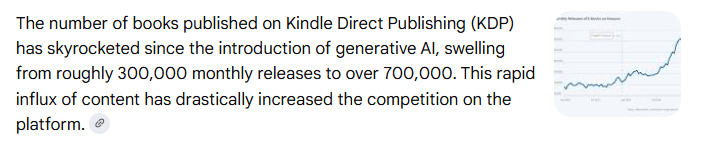
Aren’t they making a sh*tload of money publishing fiction novels?
(Or perhaps they just didn’t think of it.)

1 Like

They’re certainly drowning Amazon in sh*t, but I don’t know how much money they’re actually making. I see a lot of “how to make money with AI” courses, which usually means they hope to have more success fleecing the sheep than actually doing the advertised thing.

1 Like

I am pretty sure they have no interest whatsoever in publishing books.
It is not them, doing that ; just the new breed of “writers”.

P.S.
Might as well reiterate it :
I am not interested in AI in Scrivener. Not even an access/parallel facilitation. No.
(My opinion. To everyone his/her own.)

Also, I don’t quite see “fair use” if the result is such numbers.
I believe there is a huge difference between quoting a few lines from someone who wrote something smart that goes along your content, and a massive boundaryless fetch.

5 Likes

I’m sorry to say this, as I’m someone who is very anti- AI myself, but your arguments are increasingly coming across as wishful thinking.

2 Likes

shrug The conversation has gradually shifted from an ethics conversation to a business conversation. Plenty of unethical things are financially profitable.

I believe that the business case for LLMs is extremely weak, and that the LLM market bubble is likely to pop before any of these companies prove me wrong.

But I also believe that these are unethical companies with unethical business practices, and that will continue to be true regardless of the amount of money they make.

5 Likes

We agree here. But it won’t make a difference. The dotcom bubble burst, but I hear the internet is still occasionally used.

2 Likes

Yes they are. Regardless of what the courts say.

4 Likes

Fortunately, our society operates under the rule of law, rather than your opinon.

2 Likes

In the case of AI training, the “fair use” is because of transformation. Duplicating an entire work is copyright infringement. Using a copyrighted work to create substantially different works is transformative and permitted.

Forget the computers for a second. If a human cut up 1,000 novels and put together a new work of fiction assembled from phrases from all the books, it would be transformative, and therefore legal. LLMs are just doing this more efficiently.

2 Likes

…yet, you can ask your friendly AI to mimic this or that author.

All this made possible thanks to stolen copyrighted work.

It might be a new type of stealing the law isn’t prepared for, but it is stealing just the same.

If I am starved and steal food from the grocery store, it ain’t fair use. Yet, there is transformation. And also, I’m starved.

5 Likes