I am a new writer who uses Google Doc. all the time but have not written a professional film or tv script yet to pitch to media companies, [Indie or mainstream] [Production/ distribution] Film Companies, or producers. I want to know the real process on writing a script and the real process of a pitch meeting. Similar to Prince [Music Artist] as he owns his masters. I want to own 100% of my script and IP with having creative control. Is there anyone with ideas?
Hi, Pro Screenwriter here (USA-WGA) - let me see if i can help you:
Read this book. It’s the best manual about how a screenwriter’s career works. it has everything from writing to pitching to working with agents and producers – by a couple of guys who know what they’re talking about.
You have a choice: you can either pitch your story to a studio, OR you can own your script and have creative control. If a studio loves your pitch, reads your script and buys it, they’re BUYING it. They own it, not you, and they have control over it.
If you want to own your IP, YOU have to become the studio. You need to pay for production and find distribution.
Prince is a great example. He worked for the record companies, so they owned everything. Once he became really famous, he didn’t need them anymore to sell records. Once he got out of the contract, he paid for his own recording and promotion and owned all his masters forever more.
Also, once Prince became his own studio, he became crazy prolific. They say he left thousands of unreleased songs behind. He made so much because now he was working for himself.
So if you want to own and control your IP, you have to become the studio.
Hope that helps.
2 Likes
Is there a way when the final draft of a script is finish, should I talk to a lawyer and create a contract for my script?
[Basically: A script under contract with the writer having 100% of rights, IP, and license.] Similar to Prince when owning his masters.
Talk to an entertainment lawyer before signing anything, sure. But a contract can’t force a studio or producer to let you keep 100% of the rights. That’s something you’d negotiate if they’re interested in the script. For a pitch meeting, focus on selling the story first and worry about contracts when a deal is actually on the table.
You won’t need a lawyer or have to worry about pitch meetings for a long time. A very long time. Start writing your first script.
2 Likes
And your second. Third. Fourth, fifth… and on and on.
3 Likes
As I menioned above, Prince owned his masters once he started paying for them to be recorded. He became the record label.
Tyler Perry has done the same thing. He put on his own plays, and kept 100% of ownership. When Hollywood came knocking he said no until someone offered him ownership in exchange for paying a share of revenue.
If you want to keep your IP, you have to develop it into a very valuable property nearly guaranteed to make money. Then you can cut a deal like Tyler Perry.
2 Likes
Bought. Read. Laughed. Learnt stuff. Thoroughly enjoyed.
Thanks!
1 Like
One thing I’d suggest is learning the business side of screenwriting as much as the creative side. A lot of new writers focus only on the script, but understanding how films get financed, produced, and sold will help you set realistic goals for ownership and creative control.
Also, don’t wait until you’re “ready” to write professionally. Start writing scripts now, make mistakes, and improve with each one. Every finished screenplay teaches you something that books and advice can’t.
1 Like
Multi-CUBE22, if you have a chance to be a good writer, you’ll know it soon enough just by exchanging SMS or email or possibly other methods of communications with written words with friends and family and relatives.
I smell in the OP a lack of confidence. So you need to give that serious consideration first, as in: Can I do it?
One easy way to find out is if you can make yourself laugh with a funny story.
Heck, try writing us a funny story of only about 5 or 6 or so sentences right here in this thread.
Oh yes, and one way you can know you have the skill is if your fingers start typing stuff that your brain wasn’t expecting.
One more thing, don’t pay any attention to nutcases like me. You’re sure to be a flop, if you do. Or don’t.
Not seeing an edit tool after posting, so let me add a note here:
I erred in having that show as a ‘reply’ to popcornflix.
If there’s a little pen icon under your post, that’s how you can edit it:

2 Likes
I appreciate that feedback, but that cute little icon didn’t show itself back when I was trying to find an edit button.
BUT, I was recently promoted by some gal/fella named “system” to one trust level higher, so maybe I am not allowed to use that cute little pen and edit stuff.
On a separate note, I wish for that gal/fella/other “system” to give my wife some hints that promoting me to a higher trust level is a good idea. Then I might get to use the oven, again. I can now be trusted not to burn dinner.
See; harness the power of AI to improve human-to-human relationships.
Oh yes, I obviously believe AI should be allowed gender attributes. Just using “IT” isn’t so kind to your future boss.
. . . . . . . . . .
Yep, that trust promotion was the key that unlocked that cute little pencil. Just took a look at my files from yesterday and that screenshot of that post clearly indicates that a ‘no trust you’ newbie isn’t allowed a dangerous tool, like an edit tool.
EDIT #2: Nope, I just saw some notification that I “earned” that cute little pencil/pen. Now that is interesting. Can’t recall seeing that parameter on a forum platform before. Very interesting. <I remember some TV series where that “Very interesting.” was a cute line in the script. Smothers Brothers Show? Maybe as a tag, or preceding a tag?
If you want to be a screenwriter and make movies or TV shows, you need connections. People in the industry work with people they know, who’ve proven they can get the job done without causing problems for the rest of the people involved with the project.
So, get yourself a job in the industry. Any job at all. And make a point of showing up on time and being useful. That’s how industry people network, and networking is essential. Be nice to everybody. You have to earn the right to be a jerk in that business, so don’t get ahead of yourself.
If you don’t live where screenplays get turned into films, move there. It’s almost impossible for someone with no connection to the industry to succeed from the middle of nowhere.
A great screenplay is worth more than an MFA in creative writing or a film school degree, but studying film and screenwriting at a good college is better than trying to figure it all out on your own. Either way, read screenplays, lots of them, so you start to understand what makes a story filmable.
I’m going to use a “Reply” instead of another edit.
I’ll admit to less brain ability these days, but this is not making sense to me:
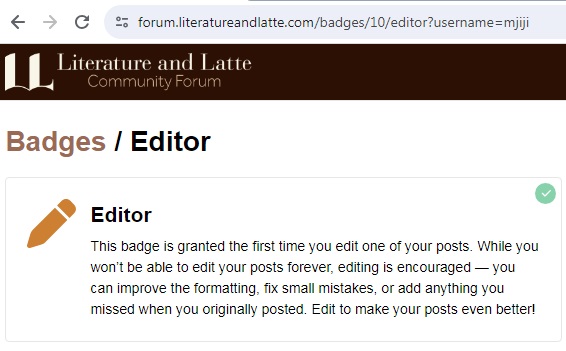
If I hadn’t seen that icon in the post UI before, as was the case yesterday JST, how could I have done an edit to get the “badge”?
Did the ability to edit come with that ‘trust thingy’ first AND then I get a “Badge” because I did an edit?
So let me try again: Newbie, so no way to edit a post. / Trust up one notch, so now can edit a post. / Did an edit and so I get a “Badge”. One, Two, Three; is correct?
Seems I better get a uniform when I am at my work station and on this site. Tailor stitches me a new L&L uniform and I place all these “Badges” on my uniform and then log on.
EDIT: Just a note, that text in that box in that screenshot is poor writing. For example, how long is before forever? And I can only edit “small” mistakes? Not big ones?