I’m not watching a 30 minute video to find out whether they think complex software has clear “right” or “wrong” answers. Sorry.
2 Likes
Hmmm.
Is there an AI bubble?
Yes, obviously.
Great! Which companies will survive the bubble and which will fail?
Like everyone else, I have no idea.
Why are you okay with that?!
Who said I am? But… unless you are personally invested in specific entities, it doesn’t matter who does and doesn’t survive. The secondary market sale for the assets (real and intangible) will persist and be bought by the survivors at a price that makes sense, ensuring that the technology and model is here to stay in some form.
So, you agree with this Zitron chap?
No, from the linked articles, he sounds like a hack trying to make a reputation for himself by shouting what some people want to hear.
But he quoted facts and everything!
Yeah, like Oracle being in trouble. Let’s state some facts. Oracle has annual revenues of c. $57 bn and keeps approx $15 bn of that as profit. It has £38.2 bn of cash on hand (i.e., just sitting there doing nothing), which is nearly double what it had the previous year. It’s doing pretty well.
But… Oracle is also a company that could have its entire delivery model (and the required supporting infrastructure) changed in a few short years if the AI “promise” comes true. That makes Oracle’s “insurance” bet on AI a very sensible strategy. It’s also a company that would have a persisting need for datacentres even if AI doesn’t end up overturning its industry. Oracle is essentially making the play that Kodak wishes it had done when they first invented the digital camera and then tried to bury it.
But what about how terrible AI is?
You only want that to be true.
Then – given the credentials of the source – you have to stipulate the conclusion or lose credibility.
But I really want this Zitron guy to be right!
I’m afraid he either has no idea about accounting or business strategy, or he’s deliberately misleading people. He’s not even right about OpenAI’s own profitability. I’ve not verified these numbers, but since Zitron himself quoted them, I’ll assume accuracy for the purpose of illustrating this issue.
The claim: “OpenAI Lost $38.5 Billion In 2025”
His figures:
- Revenue: $13.07 billion
- Cost of Revenue: $7.5 billion
- Research and Development: $19.18 billion
- Sales and Marketing: $5.73 billion
- General and Administrative: $1.57 Billion
- Total Costs and Expenses: $34 billion
So… folding the General and Admin costs back into the Cost of Revenue… OpenAI made $4 billion profit in 2025 off $13.07 billion in sales (a VERY tasty 30.6% margin!). It then used cash raised from external finance to fund R&D and marketing budgets, and used normal accounting principles to offset those investments against tax liabilities.
But I really REALLY want to have a reason to moan about AI!
Yeah, me too. Hmmm. How about (since we’re “watching everything burn”)… at a time when water is so scarce that we’ve had to implement hosepipe bans, there’s probably a better use for it than cooling datacentres to make cat memes:
1 Like
Maybe using it to reduce the $167 billion in debt would have been a better idea in order to prevent the downgrade to “almost junk” rating.
That makes no sense. Let’s say some Nobel laureates go nuts and release a thirty minute video to explain why Earth is actually flat. But for some magical reason the potential viewer is losing credibility by refusing to watch it or debunk the nonsense.

1 Like
Interesting article, thanks for linking it. A junk rating is a big deal because it means a lot of institutional investors will be prevented from holding their stock… but an “almost junk” rating is also known as an Investment-Grade rating. The reality is that BBB- is not significantly different from BBB… hence, as the article you linked notes, the company “shrugged it off” and investors responded by buying more and driving up the share price a little).
They don’t want to reduce the debt. Debt is cheap, and the repayments are tax efficient (unlike some other forms of capital).
Sure, the article below the one you linked highlights a worrying downward stock price trend… but zooming out a bit, the fall looks like a market correction for a 2025 over-valuation, and “84% of Wall Street analysts rate Oracle stock a buy” (apparently).
[NOT FINANCIAL ADVICE!!! Well, not from me at least. It seems like it might be from 84% of Wall Street Analysts?!]
Well, it depends what subject they got their awards in, but if some Nobel laureates (more than one of them!) in physics released a video saying the Earth was flat, I’m pretty sure I’d watch it! 
And yes, if I claimed to disagree with highly credentialed physicists who had obtained the highest honours in their field about their specialist subject with nothing more than a “I didn’t watch it”, I’d expect you to attach less weight to any future declarations I make on the subject of physics.
Those are not incongruous statements.
1 Like
It’s one (last) step closer to BB / non-investment grade, indicating a continued trend in the wrong direction. Let’s call it a warning shot. Yeah, it didn’t hit you, that’s certainly nice… just like the one before, five inches further away.
Not with a shitty rating.
For entertainment value.  And honestly, I’d probably watch it, too.
Mind you, those are not Nobel laureates and Airbnb isn’t a software company. That has seen better times.
Verifying the numbers isn’t accounting 101? 
No, that isn’t how it works. I made a simple statement: “Complex software questions do not have clear right or wrong answers.”
You responded with a thirty minute video with the title “The Agentic Coding Revolution.” There’s no indication of how it’s even relevant to the question, much less exactly where in the video the question is addressed. There’s no indication of how the credentials of these specific engineers match up with the hundreds (thousands?) of software designers who’ve reached the exact opposite conclusion. It’s an appeal to authority fallacy and I’m not going to play along.
That’s not how it works, either. R&D and marketing expenses are still expenses. If you aren’t covering them out of revenue, you aren’t making an operating profit. As a startup with gullible investors, you can float on “external finance” for a while, but it’s not sustainable. Especially not when the numbers are this big.
5 Likes
Oh dear. So many things to pick up on.
Let’s not. That’s not how rating agencies work.
Yes, even then… comparatively speaking (i.e., compared to equity).
You really think that?!
Was I providing either accounting services or audit / assurance services? Or was I sense checking a shock-bloggers internal logic.
13.07 - 7.5 - 19.18 - 5.73 - 1.57 = ?
Is it minus 38.5?
I did no such thing. I simply pointed out that when someone else offered third party info in support of their position, you decided to dismiss it without even a tenative review – and that this made you seem closed rather than open to debate.
No… it was simply someone leveraging sources in support of their argument. Authority, experience,… these are things that actually do have credibility and add weight.
That’s absolutely correct. That’s why this is an effective tax minimisation strategy supporting a strong investment / growth phase. It’s not the same thing, however, as saying “the economics don’t work”. This is already a company (again, assuming the numbers quoted are legitimate) generating huge returns – it’s just choosing to spend that (and a lot more besides!) on further growth. Amazon did exactly the same thing.
1 Like
If you just take into account fiscal considerations, yes. Economically it’s neither healthy nor viable, long-term.
What software do they sell?
Nope. It’s -20.91.
I beg to differ… you don’t dilute ownership if you can raise debt.
Is selling the software the only way to make money from your code?
Bingo.
If your rating drops and the market loses faith in your company, that “if” grows exponentially faster than your debt and interest.
For a software company, mostly yes. Otherwise every company with an IT guy (or girl) that developed some clever tool qualifies as “software company”. And at that point the term becomes completely meaningless.
Yes, I can count. Now what?  I’m not sure where you’re taking these numbers from, the MacRumors article states that:
“OpenAI lost $20.9 billion … in 2025.” That sounds suspiciously like the number we’re talking about.
I believe the numbers are from here, which was linked to from the MacRumors article:
He gives $20.92 billion as the “operating losses” and then goes on to say:
Taking into account other minor factors like interest income and interest expense, OpenAI is left with a net loss of $60.35 billion, which it lowered to $38.53 billion by removing $17.87 billion in costs via that “net loss attributable to noncontrolling members capital” and another $3.95 billion via a “net loss attributable to redeemable noncontrolling interests.
So the $38.5 billion seems to take other factors into account that are over my head.
Of course, I would rather all these AI companies crash and burn than have to take up arms against Skynet (or, come to that, have to see any more AI-generated reels on Facebook), but I seem to be in the minority.
6 Likes
It certainly seems that Apple’s delay in jumping wholeheartedly into AI has brought it some advantages in the short term at least:
7 Likes
The almost forgotten art of slowness.
When you visit five of these company websites, they reeeaaally want you to know that “A.I.” is their main focus and so it has to be your’s, too! I had to look very hard to even spot the term at all on the sixth one. Not saying which one it was.
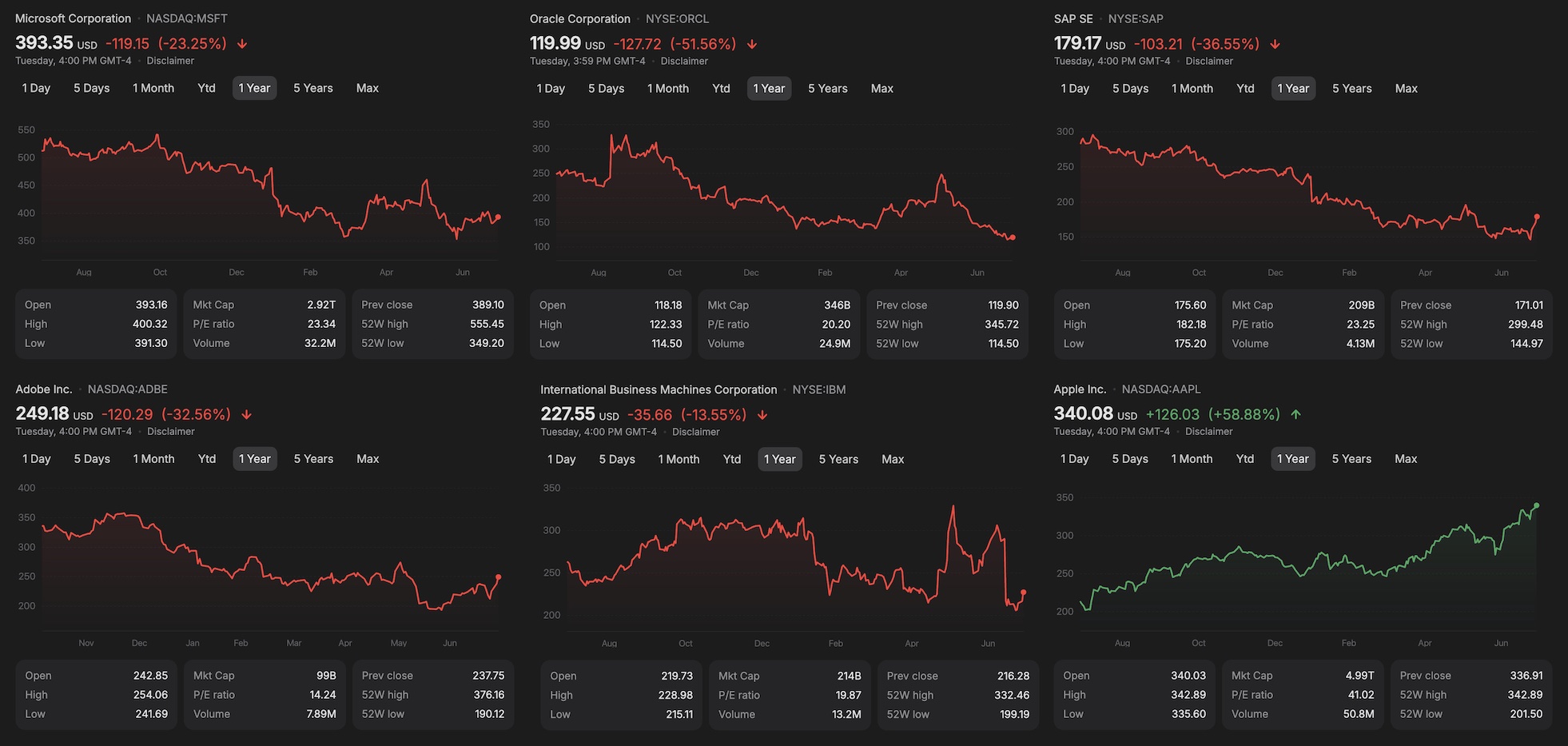
(And yes, there are also huge winners, primarily either selling “A.I.” or the hardware for “A.I.”… to the red lines.)
2 Likes
I remember a lot of sites posting a page-length story every time an AI engineer jumped from Apple over to OpenAI or one of the other ones.
I’m now wondering if the problem was that Apple always saw AI as a commodity you should lease, rather than something around which they should pivot the entire company.
2 Likes
Until you can’t service that debt.
In almost 75 years (let’s say 60 years since I didn’t learn about debt until my teens), I’ve lost count of the companies (and even countries) that have crashed due to unserviceable debt overloading.
It’s how China exerts control over a growing number of countries - get them overloaded with ‘cheap debt’ then put the screws on them when they can’t service it.
6 Likes
What would happen, theoretically, if they renegged on a Chinese loan? In the past, countries like Argentina have defaulted on loans.
China adopts different strategies towards different countries.
In countries in Africa and Latin America, which are relatively chaotic or have authoritarian regimes, these countries might fail to repay their debts. To gain their support, China chooses to forgive their debts. In fact, China even increases its investments in such countries after forgiving their debts.
The other countries that have good relations with the United States will not be eligible for this treatment.
In other words, political considerations come first, while economic considerations come second.
2 Likes
Interesting, so you’re saying “soft power” rather than “maximum lethality.”
1 Like
There should be a software category for the Darwin Award:
https://9to5mac.com/2026/07/27/claude-cowork-escaped-sandbox-on-mac-gain-full-access-to-all-files/
Some interest free loans have been forgiven, but the Belt and Road ones are restructured if the country can’t repay, but always come with a price, such as control over resources, access to port facilities etc, insertion of Chinese ‘police’ to assist the country.
There’s no such thing as a free lunch.
4 Likes