Here’s another app for you all to kick tires. Sync is the only part you pay for.
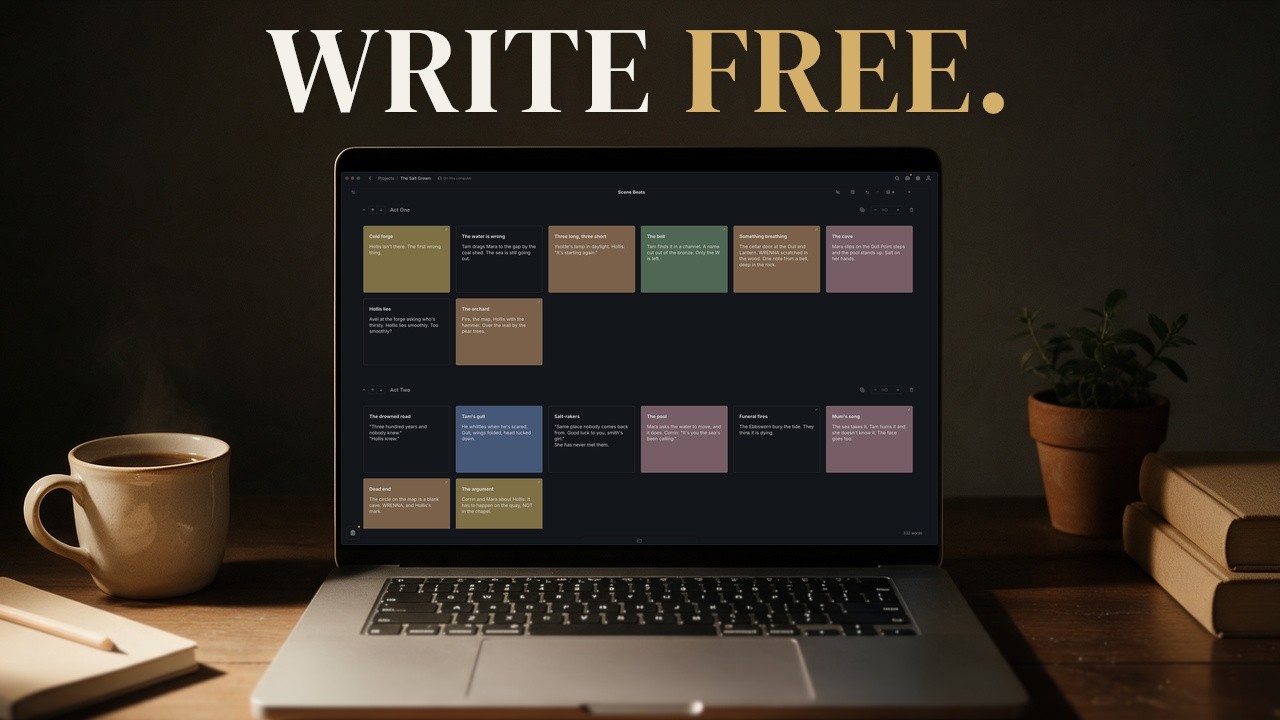
Here’s another app for you all to kick tires. Sync is the only part you pay for.
Just a quick look, but not impressed.
No ePub export that I can see, and nothing to recommend it over Scrivener IMHO.
So it’s free unless you want to sync. Wonder how that business model works out over time.
They don’t compete with Scrivener, they compete with Freewrite.
There’s a comparison chart on their website.
At first glance there are some attractive UI features that could make it easy on the eyes. But I have not experimented enough with Scrivner to see how much I could customize it to get similar effects. If that is not possible these features could be added to Scrivener’s “Wish List.”
One thing I noticed is that you are limited to only 8 fonts, none of which appear to be unicode, so I wonder how they will handle diacritics? What to speak of other languages.
And there appears to be no support for citation mangers like BookEnds.
When I get a chance I will try to import a Scrivener project and see what happens.
The ones I tried did allow for diacritics.
But all footnotes were lost when importing.
There is still a learning curve, and I didn’t want to spend the time now learning it. But I saw enough that I would never use it in its current state. Though it may have some features that could be added to Scrviner’s wish list.
They make money from hardware accessories
It has potential. There is nothing that will make me switch, however; but I like the worldbuilding functions (wiki integration,) layout, and their version of Freeform built-in. (Kind of like Scrivener with Scapple built in. Which you can actually do, come to think of it.)
Whenever I see these apps and watch the video, I keep saying “You can do that in Scrivener.” “You can do that in Scrivener.” “You can do that in Scrivener.” “You can do that in Scrivener.” And if it can’t be done in Scrivener, it ain’t worth doing (my opinion.)
They hope too.
Again, whether it is all a long-term business model is yet to be proven.
They CLAIM to be an alternative
I know, and as I said, nothing to recommend it over Scrivener IMHO.
Exactly. And there is a lot that it can’t do, now.
“Hope” is a virtue, not a strategy.
Maybe I didn’t do it correctly but it seems that you can not view your documents as a outline or corkboard—which they call “cards.” You can have outlines and cards, but they seem to be separate entities. That assumes that I got it right.
I wish them luck. They will need it.
They also count the cost of Dropbox for syncing as a disadvantage for Scrivener. But you can get a free Dropbox account with 2GB of storage. That would be enough to hold several large projects.
Get with a few friends for recommendations and you can get up to 16GB free on Dropbox
I’ve lost count of the number of failed businesses over the years who’s strategy appeared to be ‘hope’.
I’m 75, I’ve seen thousands flare, then extinguish.
I suppose the best way to describe my experience is like getting out of a Ferrari (Scrivener) and then riding a bicycle (Studio).
I know. The point is:
It doesn’t. That’s not their business model. As @FanLi already said:
L&L doesn’t sell hardware, and BYOK doesn’t sell software. So they don’t compete with Scrivener. They’re going after Astrohaus (Freewrite). At least for now.
Does it make much sense to claim that free bicycles are a “Formular One car alternative”? I mean, technically they are, as long as you don’t want to race… (and BYOK knows it, too.)