When personal computers arrived in the eighties, everyone went a little crazy with fonts. A bake-sale flyer might have five different typefaces on it. It looked like a kidnapping threat. But to the person making it, it felt like possibility.
We are doing the same thing with AI now. The internet is filling up with writing that is perfectly polished, grammatically flawless, and utterly hollow. Fast fashion for the mind. It looks like a suit. It fits like a suit. It has no soul.
Compare these two dedications.
“When I think about my mother there is a direct bodily sensation. In my throat and in my heart muscle. Any text that I could write would be lesser than the silence surrounding her. She is the white space of everything I write — the thing that all my writings are arranged around.”
“To my mother, who gave me the roots to grow and the wings to fly.”
Which one is written by a human and which one by AI?
The first is by a human writer. The AI version gives the shape of feeling without the feeling itself. A photograph of a fire that gives no heat.
The AI has never had a mother. It has read about mothers. It has processed ten million dedications and extracted the pattern. What it cannot do is sit with the specific ache — the one in the throat, the one in the heart muscle — and let that ache speak without dressing it up.
Photography did not kill painting. It liberated it. Once the camera could capture the fact of a face, the painter was free to capture the feeling of it. They stopped painting where the shadows fell and started painting how the light felt. They invented Impressionism.
AI is doing the same thing to writing. It has taken over the utilitarian work — the grammar, the transitions, the ten ways to save money. It has liberated the writer to do the one thing a writer could ever do that mattered: be themselves.
The person whose only value was being correct is in trouble. The person with a specific voice, a genuine wound, a real life — is not.
We do not have to be the calculators of prose anymore. The machines do that now. We just have to be ourselves.
As it turns out, that is the one job they are not very good at.
The grammar and the transitions are part of the craft of words. Ai is often wrong about them, in my experience. as I have said here before, we are all better than AI.
We can come up with ten exotic, wily ways to save money because we craft our thoughts with words. We don’t need to exclude ourselves from that work, to pass it off to tools, because that’s the real work of writing along with all the other parts of it.
Now if I can make a living and not starve to death, while the heartless, soulless, megacorp sells untold millions of AI made wdgets, whatzits, coffee cups, and T-shirts it will be a less frightening world.
Sadly, all the MegaCorps have something in common, that little box on their kindergarten report cards “Does not play well with others” is checked.
I hear your point about the ‘craft’ being the real work, jcarman. It reminds me of when I visited a hall of the old mechanical telephone exchanges. The technicians there used to say they were better than the digital ones because you could hear the relays clicking—you were physically in tune with the logic of the machine. When it went digital, that transparency vanished into a ‘black box.’
Your concern is that by using these black boxes, we lose an essential skill for our craft. It’s a valid fear; if we don’t struggle with the transitions and the grammar, do we eventually atrophy?
Look at the calculator. While it might rob a mathematician of the practice of long division, it also handles the arithmetic where humans are statistically more prone to error. Maybe that allows us to be the architects of even more complex ideas? Before calculators, I did excel at doing long mental calculations in my head. I was proud of it and I did have a ‘feel’ for the numbers. They were my personal friends. I felt that loss when I stopped.
As AI evolves, it becomes less prone to the ‘mechanical’ errors of prose. The question is whether we are abandoning our skills, or simply shifting them. If we can trust the machine to handle the ‘switching’ and the ‘arithmetic’ of writing with near-perfect accuracy (even if that is not a fact today it will be in the near future), we might find ourselves working on a different level of the craft.
You’re right, Dain—the ‘MegaCorp’ doesn’t have a heart, and it certainly won’t prioritize a ‘genuine wound’ over a profit margin. If it can sell a million AI-generated widgets, it will.
Here is what I focus on: the reader. Corporations might control the volume, but they don’t control what actually resonates with a human soul.
Think of Robert Pirsig and Zen and the Art of Motorcycle Maintenance. He was rejected by 121 different publishers. Those were the ‘MegaCorps’ of his day, and they all reached the same consensus: there was no market for his voice. They were wrong. Once the book actually reached human hands, the readers decided it was essential.
The MegaCorps might flood the world with ‘hollow suits’ because they are cheap to produce, but that only makes the writing with a ‘specific voice’ more valuable, not less. We have to trust that readers can still tell the difference between the heat of a real fire and a photograph of one. The market for ‘soul’ isn’t something a corporation creates; it’s something they eventually have to follow because the readers demand it.
But what is the “arithmetic” of writing? You use transitions and grammar as examples, but both are essential elements of the writer’s voice. (Try turning an AI loose on Mark Twain, or William Faulkner, or any other writer recognized as “great.”)
Even in Literature, AI can be a tool. We speak about Twain and Faulkner as if we know they would have hated AI, but the truth is we don’t know that.
Mark Twain was famously an early adopter of technology; he was one of the first writers to use a typewriter because he saw it as a tool for his craft. Why should we assume he wouldn’t have found a way to use AI as a ‘calculator’ for his own creative process?
An artist using a tool isn’t the same thing as a machine replacing an artist. If I use a calculator, the logic and the ‘why’ are still mine. I can still be a great mathematician. In fact many great mathematicians today use AI, and so do many great authors. If an artist uses AI, the ‘soul’ doesn’t vanish—it’s still the artist making the final choice of what to keep and what to discard.
kewms, you write as if it’s a fact that AI and ‘soul’ are mutually exclusive, but that’s an assumption. Much of the grammar and transitions—might be handled by the tool, but the choice to use them in a specific way remains the artist’s domain. We shouldn’t be so quick to tell a genius which tools they are allowed to use.
Ultimately, kewms, I don’t understand the need to attack the tool itself. If a writer feels that hand-crafting every transition is essential to their soul, no one is forcing them to use a ‘black box.’
The history of craft is a history of individuals choosing their own boundaries. Some photographers still prefer the darkroom and chemical development because they feel the ‘soul’ is in the silver halide. Others use digital sensors and AI-assisted focus because they feel the ‘soul’ is in the composition and the moment captured.
Neither is ‘wrong.’
The beauty of being an artist—or a mathematician—or a human—is that we get to decide where our ‘real work’ happens. If you find the all parts of writing to be sacred, you should keep doing it by hand. But we shouldn’t confuse our personal preferences for a universal law of art. The tool is there for those who want to use it to reach a different level; for everyone else, the pen is still on the desk.
That’s a lot of words to not answer the question. Using AI to “write” is not reaching for a calculator, it’s using a bicycle to “run” a marathon.
I think it’s absolutely legit to draw a line in the sand and say that certain tools are unethical and no one – “genius” or not – should use them. And it’s certainly legit to “attack” a tool that is built on the unpaid labor of thousands of writers, that relies on some of the poorest people in the world to “clean” its data, that leaves environmental disasters in its wake, and for which the stated goal of its creators is to render the artists you claim to be defending unemployable.
Here in lies the crux of the problem. We the poor creatives are being ‘datamined’ for the datum that is required to replace us.
Look at how AI support agents have eviscerated the customer support call center? So far, the only jobs safe from AI taking over seem to be C-suite jobs.
As posted in another thread here today, I don’t really have a problem with specialist tools in MY toolbox. I do have a problem with being a specialist tool in someone else’s toolbox…. especially when they expect my labor, my ideas, and my compliance all for the price of nothing.
There are entire genres built on re-purposing the work of others. Collage and other art based on “found” materials. Music that relies on sampling or creates variations on a theme by another composer. Essays assembled in whole or in part from pre-existing work. And in all of those genres, there are discussions about both the ethics and copyright implications of using other people’s work out of context.
An ethical AI company would engage with those discussions and figure out how to compensate their sources, rather than taking the position that “I took this stuff because I wanted to and you can’t make me pay for it.”
In theory, an ethical user of AI would behave in much the same way as an ethical sampler or collage artist: they would identify and credit their source materials. Unfortunately, because the AI companies behaved unethically in the construction of their datasets, it’s nearly impossible for a user of AI to do that even if they wanted to. It’s therefore impossible for an individual user to scrub off the taint of industrial-scale plagiarism. (Which, ethics aside, also has implications for the copyrightability of their own work.)
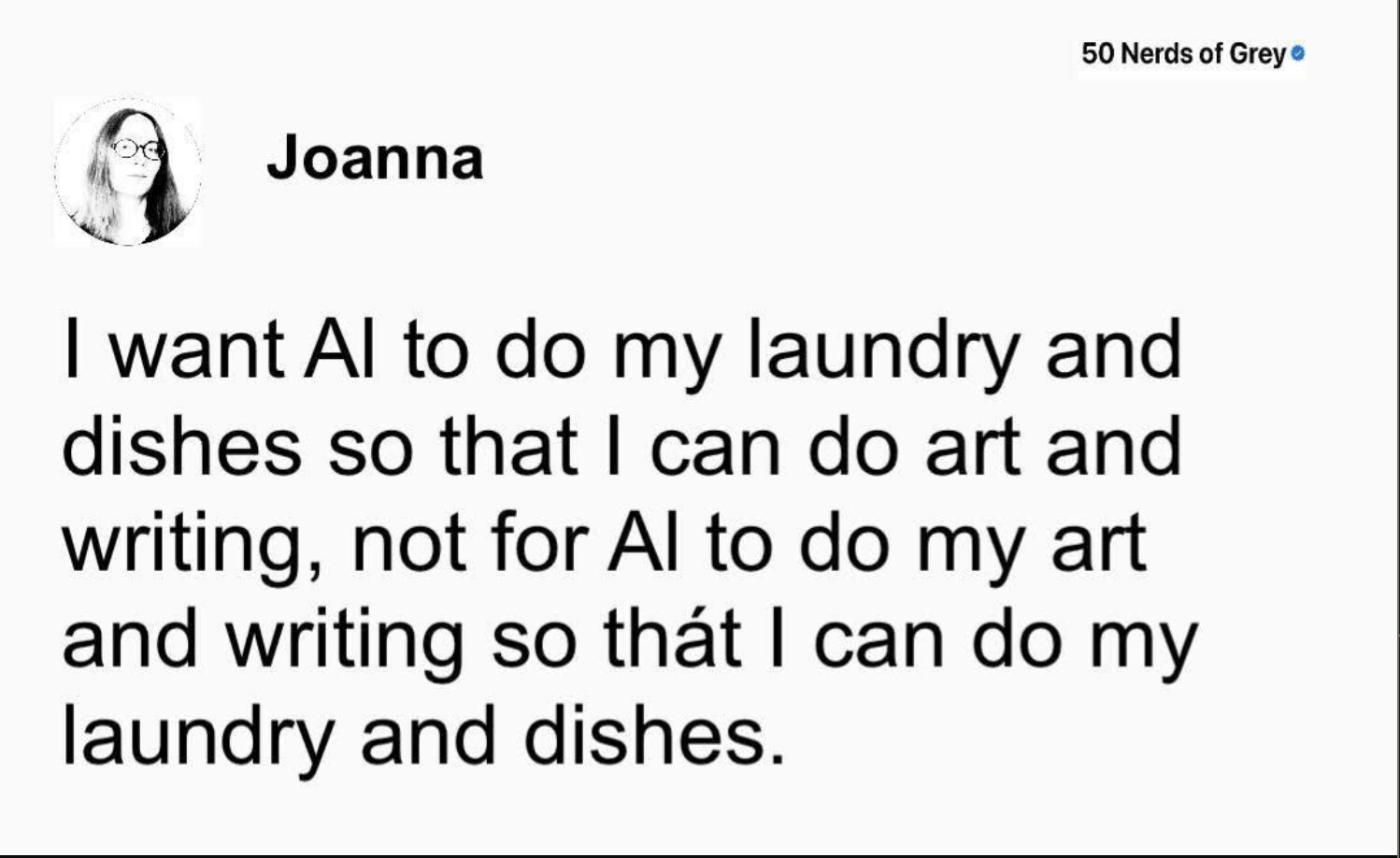
Exactly, paulcoholic! When AI catches a spelling mistake or a clunky phrase, it’s basically doing my laundry. I don’t always follow every suggestion, but more often than not, it’s right (or at least on the right track).
For example, after finishing an essay, I’ll ask for a sentence-by-sentence analysis. Usually, it tells me 95% of my work is solid, but it offers a new perspective on the rest. Sometimes I ignore it, sometimes I take the suggestion as is, but most often I use it as a spark to create my own reformulation. It saves me the busywork and gives me more time for creativity.
Corrective, rather than generative. I have no issue with AI being used like this (…if it is running locally and was trained on legitimately sourced content…)
I’d argue there are only narrow cases where this can even be a thing. The ethics of using AI that has been trained on ‘stolen’ content are environmentally and economically disastrous, taking away legitimate creative jobs and handing the money to tech companies… y’know
Here I have to hold my hand up (and why I came to this topic!): I literally work for an ethical fashion company (we are anti-fast-fashion). We do use AI extensively in various processes - but not generative (outside of code/engineering). Given what we’re trying to do (make the fashion industry less environmentally bad, reduce waste, improve worker pay), I can somewhat justify our usage - a small bad to do a bigger good. But I’m hard pressed to see how anyone could morally justify gen-ai for most creative things.
Personal opinion, not rep of the place I work etc etc…
"That’s an interesting distinction, but it raises a fundamental question about how we define ‘creative.’
Many engineers and mathematicians would argue that their work isn’t just functional—it is deeply expressive. Take something like the proof of Fermat’s Last Theorem: while the end result is ‘functional’ (a proof that works), the path to get there required a level of non-linear, creative intuition that rivals any masterpiece of literature or art.
In programming, we often strive for ‘elegance’ or ‘beauty’ in code—qualities that go far beyond mere utility. If we view a clever algorithm or a breakthrough engineering solution as a creative act, how do we morally justify using Generative AI to automate that specific form of human ingenuity while protecting others?
Do you not consider the ‘Aha!’ moment of an engineer to be as essentially human as that of a painter?"
I completely hear where you’re coming from, and to be honest, I feel that same sense of threat too. It’s unsettling to watch the tools we use for expression change so rapidly, especially when the companies behind them seem to move with a “move fast and break things” ethos that ignores the human cost. There is a valid, heavy discussion to be had about how we protect creators in this new landscape.
I’ve been thinking a lot about the distinction between the “sampling” we see in collage and how these models actually function. While it feels like a digital cut-and-paste, the tech is actually trying to mimic how we learn—by observing patterns and concepts rather than storing pieces of work.
But even if the “learning” is automated, I believe the human in the loop remains the soul of the work. An AI can find a pattern, but it can’t understand why a specific pattern breaks a heart or speaks a truth. That intent still has to come from us.
It reminds me of an interesting perspective from Mahatma Gandhi. He had a very unconventional view of “ownership” and copyright; he actually found the idea of owning thoughts to be ethically difficult, believing that truth belonged to the collective world. While that’s a hard pill to swallow in a modern economy where we need to protect our livelihoods, it’s a fascinating reminder that the “value” of what we create might exist separately from our ability to legally fence it off.
I find myself cycling through those three stages of truth Schopenhauer described whenever I encounter a disruptive technology:
Ridicule: I start by thinking the new tool is a toy or a joke.
Opposition: I feel a resistance to it as it starts to interfere with my world.
Acceptance: I eventually find a way to see it as a self-evident part of the landscape.
The “taint” you mentioned is a real feeling—it’s the friction of trying to reconcile our traditional views of proprietary ingenuity with a system that treats information as a shared sea. I don’t have the answers, but I think the ethics of the future will have to find a way to honor the human intent at the center of it all.
Different beast though. The vast majority of code/techniques and libraries are open source and literally shared in public repositories for you to do what you will with, and by their nature, are designed to be copied/updated/improved upon.
If I have an “aha” moment as a software engineer, I’m very likely to share that back to the community - either by the code living in a public space, such as Github, or by ‘pull request’ back to someone’s project - which they will likely share. While how I glue these things together is proprietary within day job projects, the code isn’t necessarily.
This is what the companies say. In practice, there have been numerous demonstrations in which they can be prompted to produce word-for-word excerpts from their training sets.
“Observing patterns and concepts” is a fuzzy anthropomorphization of what they’re actually doing, too. They use the training set to build a multi-dimensional probability surface, and use that surface to predict “what comes next,” with a little randomization thrown in so they don’t give the same answer every time.