It’s a really great solution, as good as workarounds get! Glad to hear the bug is rare now, though I think I’ll stick with this template for the foreseeable. It’s also a useful reminder that there are so many ways of using Scrivener
2 Likes
Hi,
I do I reload/refresh documents in scratchpad 2 ? I am referring to web sites and especially docs opened and modified in an external app.
In the usual Scrivener I have a reload icon at the bottom right.
thank you very much
I’m pretty sure you need the editor footer bar for that button, unfortunately. If you want more than just a text-based notepad, you’ll probably want to add it. (It’s View ▸ Editor Layout ▸ Footer View, if you’ve never toggled it before.)
1 Like
thank you ioa. I asked the question precisely because when I set the menu to View ▸ Editor Layout ▸ Footer View, nothing happens. No footer appears.
Be sure that the cursor is placed in the lower editor prior to doing this.
Should see the footer after that, like so:

Best,
Jim
2 Likes
once again, you saved the day! Works perfectly ! thanks a lot
1 Like
Hello Jim, sorry to bother you. I am using both scratchpads ver 1 for quick notes and ver 2 for temporary more elaborate notes.
I am trying to accelerate my workflow.
For ver 1 scratchpad (the basic one that comes with Scrivener), would you know if there are any shortcuts
1- to create a new document (or do I have to click on + at the bottom) ?
2- to edit the document name (or do I have to double click)?
I know that there are “undocumented” scratchpad shortcuts such as Ctrl-Tab to toggle the list of documents and the editor. Does a list of scratchpad shortcuts perhaps exist ?
thanks very much !
Hey now, that one is documented.  So are the others you’re looking for: §9.4, all in the bullet list below figure 9.2. (In short though, it’s pretty much identical to creating, renaming and deleting notes in the binder/outliner/corkboard, and that’s on purpose!)
2 Likes
I apologize for the dumb question, and not referring to the manual first.
Is there a way for Scratchpad to see the folders inside the designated “Scratchpad folder”?
I do still use Scratchpad rather than a specific “Scratchpad project” for several reasons. One of them is that I want to be able to access those files without Scrivener easily, on another computer, in markdown. The other one is that I basically use it in lieu of External folder sync to sync my Obsidian vault with it. (Why? Because otherwise I’d have to set it up anew for each Scrivener project, and this is much easier. I have a large Obs. vault that I don’t want to copy or relocate too many times unless absolutely necessary.)
Long story short: my only (but somewhat big) problem with this approach is that the Scratchpad notes list only contains what’s in the root of the designated folder, but not any subfolders. Is there any way to change that???
How can I open this template with the current version of Scrivener (3.3.1). Here is the error I get:
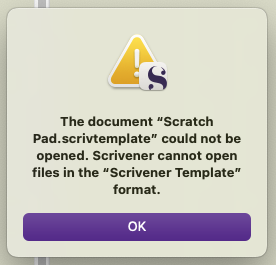
My guess is that you tried to open it like a project? Try opening the template chooser window instead, via File ▸ New Project..., and then import the template into your configuration by clicking the “Options” button in the lower left.
More detailed instructions on this can be found in the user manual PDF, §5.4.5, Managing Templates.
2 Likes
Did I miss something here? Is there really no way to set up a string search in Scratchpad? Scratchpad is valuable because it is the only place in Scrivener where one place text that is available no matter what project is open. But if one uses it as I have, to store information I need to access across all of my work in Scrivner, and one can not do searches or organize any of that info for easy access, one quickly finds that there is just too much info and finding what one is looking for too dificult to justify using Scratchpad in any substantial way. I would like to use Scratchpad to store my own personalized workflow manual, the techniques and tricks I use to make my creativity in Scrivener work for me. That way, no matter what project I have open to edit, I can refer back to Skratchpad for my own use notes and keep my workflow consistent accross all of my work within Scrivener. And because I use several computers, I can store the Scratchpad data on DropBox and access the same Scratchpad data from any of the computers that I happen to be running Scrivener. Scratchpad is a lifesaver but it is under developed for this use. Also, I have seen that Scratchpad can be opened and closed with a key combination on Windows but there doesn’t seem to be any way to do this on the Mac version? Oh, my error, in Scrivener Settings under the General tab, there is a Scratchpad pane where a keyboard combination is listed for the launching of Scratchpad. But in the “Windows” menu where the “Scratchpad” item is found, there is no keyboard combination shown.
Please note that the Scratchpad is really not designed for long term storage of large quantities of material. Among other things, because it is not part of a Scrivener project, it is not protected by Scrivener’s automatic backups.
It is, by design, accessible as an ordinary folder via Windows Explorer or Finder. So you could certainly use the operating system’s search tools to find things. Alternatively, you could create a “Reference Materials” project for this kind of material.
1 Like
An interesting project template for this : Is it possible to search the scratchpad? - #11 by AmberV (it is possible to search this forum).
2 Likes
The whole point of skratchpad is that it is pan-project. So to make a project act as skratchpad is a non-starter.
Despite all the justified criticism of the slightly outdated scratchpad, every project is just as “pan-project” as the scratchpad. What can you do with the scratchpad that can’t be done with a normal project?
1 Like
One thing you can do is access it from outside of Scrivener. It’s just an ordinary disk folder, with none of the internal metadata that makes a project complicated.
1 Like
it floats over all apps, called up in an instant with a Keyboard Shortcut
1 Like
Ok, I’ve never needed this before.
Normal projects can also float and be called up with a shortcut. Well, the second one only works with an additional app 
1 Like