Hugh Howey has officially released his new writing app. I think it was in beta a short while ago, now at v1.1.0.
Of course, it’s never going to compete against powerhouse writing apps like Scrivener or Ulysses, but it was never meant to. It’s minimalist with lots of keyboard shortcuts instead of lots of doodads cluttering the screen.
It has a basic outlining function and, surprisingly, a feature to add comments to highlighted text. A must have for even the most basic of writing apps, so I’m glad it’s in there. Chapters can be moved around easily, and they also automatically renumber!
I can see Mr. Howey put a lot of thought and care making his elegantly simple novel-writing app. For anyone who hates distractions, Neo removes them and does an amazing job of getting out of the way when plotting (optional) and writing prose. I think it’s very hard to make something this pristine.
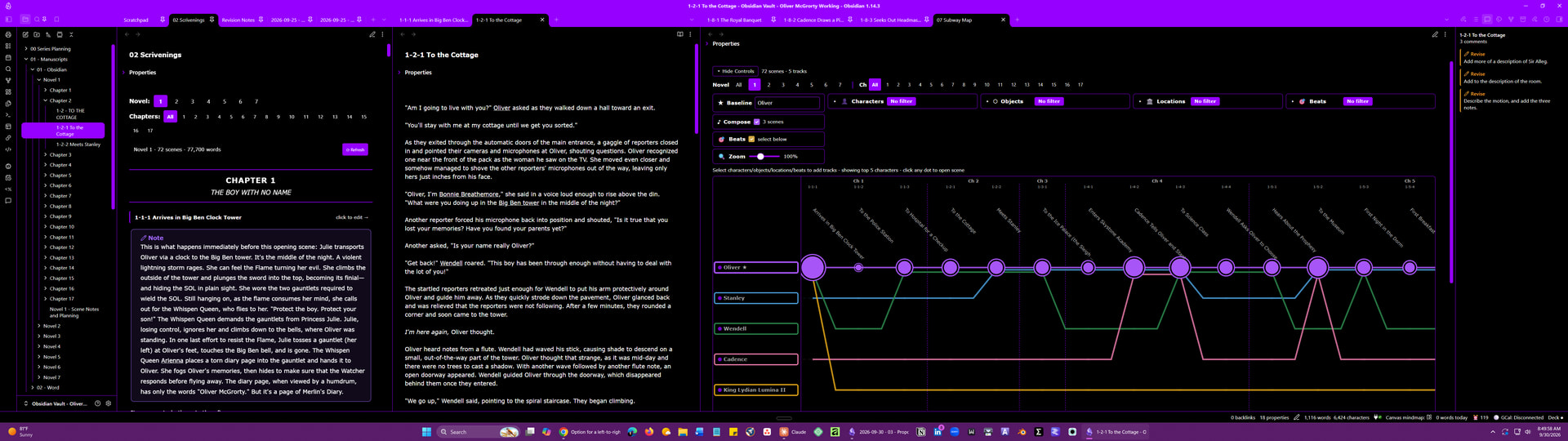
It strikes me that my own approach to making my perfect writing app goes the opposite direction, where I have built features to help me view my story from many directions.
With as many features as I’ve built, I now realize that I wasn’t encumbered by being easily distracted, to put it mildly; I tune everything out when I write.
It’s interesting how our personal traits can guide our decisions in making a writing app, even if we’re not consciously aware of that dynamic.
Indeed. This thread, and recent others, show that.
In my case, I don’t write using chapters – it’s pretty much the last thing I do – so Hugh’s impressive app is no use to me. I write scenes, of course, but the connections are their arcs. Scrivener gives me just enough for this, though I do combine it with Aeon Timeline – v2, rather than the latest version because I fits my need far better [another example of differing personal traits].
On a personal note, I retain a lot of partial details about my stories, but the memories are often associated with mood, and thus imperfect. Because of this, search is a primary tool. Scrivener’s search, and the way it presents results and allows you to navigate and manage them is key. I don’t need metadata to guide me to locations in the story.
…or in deciding which one is ‘the best.’ For me, that’s Scrivener, hands down, debate over.
But by participating in or reading online debates, I realize that despite the perceived ‘flaws’ and ‘inadequacies’ of other writing software, the ‘best one’ is that which helps us write. Everyone’s brain is wired differently and despite my perceived superiority of Scrivener versus everything else, I can appreciate that someone’s mind may not be wired to use Scrivener. (That isn’t a condemnation or implication that they’re dumber.)
(Case in point: I’ve tried Aeon Timeline twice; forget it, I just cannot wrap my brain around it. Scrivener’s ‘steep learning curve?’ LOVE IT! GIMME MOAR STUFF!)
Although he has since signed distribution deals with large publishing houses around the world, he has continued to maintain the publishing rights and direct control over all e-book publishing.
He turned down seven-figure offers in favor of a mid-six figure sum, in return for maintaining e-book rights.
I wouldn’t ever consider printing from HTML directly, if that is what you are referring to. What matters most to me is the writing itself, at best in rich text and not in a cumbersome and restrictive format like Markdown.
But I do write in Markdown. Because a) the to my knowledge by far best note taking software on iOS is the Markdown app Drafts, b) it is super easy to have scripts alter plain text Markdown files in DEVONthink where I store the notes, and b) I can move the notes with intact footnotes into Scrivener only as Markdown and not as RTF.
So I would applaud a new rich text format that replaces RTF which is ancient and maimed in TextKit. If it was actually something everyone could use on every platform and not just another niche text format.
So, from my user perspective and without knowing all the technical details and hurdles, I thought maybe not a new format but a format like HTML, which is practically everywhere, could be a solution. Not to use it as a print template format, but as a writing format that also could be processed for print easily.
I am aware of that. And of course writing Markdown is more human-friendly than writing HTML code.
But that’s what baffles me: We have devices that fit into our pockets and we can record and edit 4K videos with them. But we can’t write live rendered HTML just like that? Is there actually a technical reason or does no one care?
And again, I am not fixated on HTML. If there is a free format better suited for text, then right on! I just don’t know about any. ODT was an attempt and is free, cross-platform and fairly common. But I have never seen it outside of Open Office and its forks. And as an export format, of course. Just not in editors for some reason.
I suppose for me I just want a frictionless writing system that does things my way and is tailored to my own current writing project, a multi-novel fantasy series.
I am in awe of Scrivener, and even after many years using it am still discovering its full capabilities. I use it for many writing tasks and recommend it constantly.
But for my fantasy novel project, I was growing frustrated switching back and forth between Scrivener and Aeon Timeline, even though they sync. I kept getting pulled out of my story as I grappled with coordinating two apps that were separately developed. I wondered if there was a way to combine the features I used from each into just one app, and that’s what got me thinking. My “aha” moment was when I realized that with an up-front investment of my time to learn how Obsidian works, especially the free community Datacore plugin, I could roll my own writing system.
For me, it’s not about making a “product” for others, as I’m my own customer, so to speak. I suppose I could polish up what I’ve created and sell it, but I’m determined to write, write, write. I can’t imagine (or maybe I can) the kind of hell I’d be walking into by trying to please customers (hats off those brave enough to do that!), as it’s hard enough to please just myself.
Most Markdown editors that offer an inline formatting preference (such as the composition window right here in this forum) are essentially HTML editors. If you switch off Markdown display on the left of the toolbar, formatting will be rendered without the markup, and it will of course be rendered using HTML and CSS.
But the reason why I don’t think I’d ever be enticed to use an HTML based editor is that I don’t use Markdown because it can create HTML, I use it because it can be used to create hundreds of other types of files at a level of quality that typically exceeds anything produced by rich text tools. It’s a nexus format, not an end product. HTML is an end product. Sure, you can convert it to other things, just like you can try to convert a LaTeX file to an HTML file, but conversion is never going to be as precise and effective as a tool designed from the ground up to produce other formats.
Anything that avoids allowing one to write with Markdown in it is kind of uninteresting to me, no matter its feature set. I don’t think rich text (regardless of the save format) looks good, nor do I find interfacing with the buttons and menus it generally requires to be efficient. I prefer to see the markup and edit it directly, and I prefer the ability to copy, paste or save, sync and export/import with 100% compatibility between all software, text fields, and devices. Using HTML would merely swap one set of limitations found in RTF for another set of limitations.
As to whether RTF is a suitable file format for saving Markdown text, I’ve written quite a lot on that, and how it does allow for a unique set of capabilities that I don’t think you’ll find anywhere else out there. I’ve never entirely understood the hang-up with the save format, beneath the software’s interface, to be honest. I get some of the arguments to be clear, it would be idealistically nice if Scrivener saved its content in a clean and simple format like Markdown, but I don’t actually go into its content folder and edit any of that stuff anyway.
Aside from this not being too useful for non-fiction, the lack of Markdown would be a deal breaker for me. A pity since it runs fine in Linux. But that’s just me, I wish Mr. Howey all the best with it, and love his books!
I suppose the sensitivity is in the durability of the work in the case that the writing app “goes away” (which is an overblown worry because it would have to become unavailable from the vendor or third parties and would have to be deleted or otherwise unavailable on the user’s own machine–theoretically possible, I guess, but a distant risk). Personally, on this criterion I’m confortable that apps such as, of course, Scrivener, that save work in RTF format files is perfectly acceptable as many writing apps handle it just fine.
That’s part of the lineage of Markdown as well, definitely. There were, once upon a time, a bunch of notetaking tools that used their own proprietary formats, leading to much wailing and gnashing of teeth (and orphaned data) when they folded. There also were (and are) a bunch of tools where proprietary formats make it difficult to extract your data if the tool no longer meets your needs for whatever reason.
I’ve no doubt AI making it easier has something to do with it.* Howey uses Claude if you check out the github page.
*Not that I’m an expert in these matters, or how much AI makes things easier, as my programming knowledge is pretty much zero. As nice as Neo is, I’d rather use L&L’s upcoming Mac native app over a vibe coded Electron app.
And now I’m curious, as someone who’s familiar with his work but not a reader or a fan, if he uses it in his writing. I’d like to believe that he doesn’t but I find it hard when it’s used for other things. It’s kind of disappointing.
I’ve just remembered he’s one of the authors singing the praises of Sudowrite (AI writing “tool”) on its homepage. I’ve checked and he’s still on there. It’s only a very short quote though, and I don’t even know if that means he uses it or not. He maybe tried it once and said, “Yeah, it’s good” and that’s it. Hard to say.