Neo by Hugh Howey

I assume you marked the bit where they delegated a lot of the work to AI?

The essential issue is that there is no control of any of the important variables, nor detailed analysis or measurement of them. They are taking a huge mass of data made up of a multitude of populations, squeezing some numbers out of it - and if you have any experience with such things you will know that you can get any numbers you want - and then validating what they have done with quotes from qualitative interviews.

“We gather information on the procurement processes across different firms through qualitative interviews.” I didn’t see any detailed description of how they selected the firms, or the interviewees, or indeed any of the quotes in the paper.

From my point of view it’s pseudoscience not science.

The first author is a doctoral student in Business Economics; the second is a Ph.D. candidate in Economics.

2 Likes

It looks like you may have accidentally cut off part of my question and therefore didn’t get a chance to respond to it in full:

Be wary using this. It seems to randomly decide to not save work. And since, as far as I could see, there’s no way to manually initiate a save, you’re rolling the dice as to whether or not your writing will show up the next time you open the app.

2 Likes

:red_question_mark::red_question_mark::red_question_mark:

2 Likes

Hang on, let me get my foot out of my mouth.

3 Likes

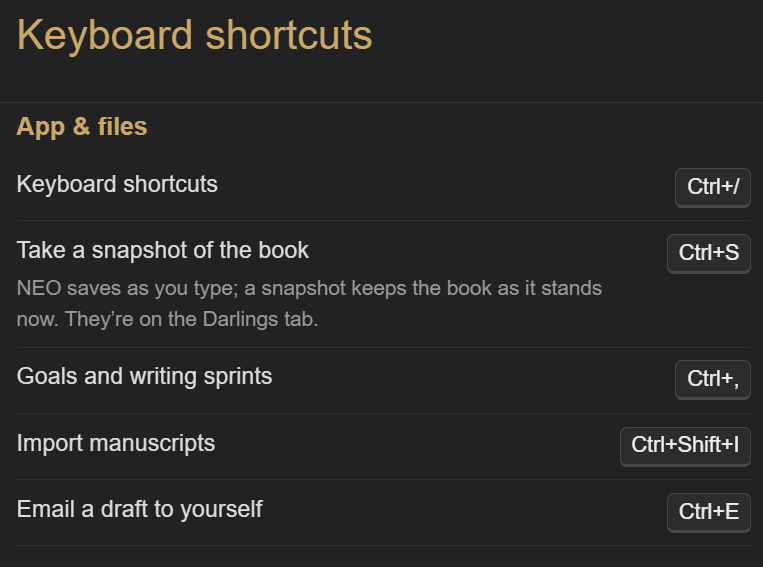
That’s not really a save, as such. It creates a snapshot within the manuscript a bit like Scrivener. If you kept hitting Ctrl+S, you’d end up with a stack of snapshots you don’t need. And currently, there appears to be no way to delete them.

So @jprynces , your foot was never really in your mouth to begin with! :grinning_face:

2 Likes

I haven’t checked the whole structure of how things are done.

One thing to bear in mind is that it is effectively a plaintext json database, containing multiple json files. iirc saves etc are incremental, not resaving the whole thing to save disk space.

There’s regular autosave. As we know there can sometimes be glitches with autosave processes. With other programs there appears to be a sensitivity to computer being closed before the autosave has completed. I haven’t had any problems with Neo myself, but I’m aware of the wider risks.

If you have your file in a cloud drive folder, then that will be collecting multiple versions too.

There are daily backups.

Work can be saved any time through the snapshots,
or by export (a variety of options available),
or by the simple email to self.

I also have a backup system for the Library Folder itself.

Risks to your work are lower than with many programs.

There are many rough edges and things that might be improved, but it’s pretty robust on ways to secure your work.

It’s might be reassuring if you use a text editor or a json editor to go through the files to see exactly what is saved and where. Being plaintext it’s easy to extract the text should you ever need to - but the other methods are far easier for anyone that uses them.

There were two major issues which could cause permanent data loss open for 6 days, just merged today. This was, of course, after the author of the software stated they were all good and done and the software was stable and “happy writing”.

Completely separately and not reported or fixed as far as I can see, removing a chapter with an outline attached, and putting that chapter back via Darlings or a snapshot does not return the outline data, meaning the outline and the text are not truly connected and can become separated and lost. Whatever you outlined via the outline or card feature for that returned chapter is forever gone, so I hope you didn’t assume “outline feature” meant something you could always refer to and rely on.

There was an issue where a portable version of the software would download and install a normal version on every quit.

This software is versioned at 1.6.2, which means stable, major problem free, and data safe.

It is in fact none of those things, and went from version 0 to 1.6.2 in less time than a real, human made application would spend in testing a beta version.

You can’t vibe what amounts to a fractal of interweaving logic thousands or millions of lines deep, which require all systems interact in understandable and logical and safe ways and then expect it to be safe for people’s irreplaceable data. You can vibe a kitten holding a balloon. You can vibe a thank you message for your email. You can’t vibe data security or reliability. These things require oversight and testing.

Beware the grue which lurks in the dark rooms, fair adventurer, as I’d not place my words in anything not thoroughly vetted over a good long timeline.

These things are hard for a reason, and take time due to the real concerns you have to take when promising to keep a 100,000 word novel safe and without missing bits and bobs or lost outlines.

And just because a company tells you their magic coding bot can do everything you ever wanted, doesn’t mean things aren’t bubbling and churning below the surface you can’t account for because a person didn’t write the code to begin with.

And a slick UI can hide an awful lot of bad code.

5 Likes

I’ve been using Neo on Mac and iPad and it certainly looks very pretty. However just to reiterate what you’ve said, I too have suffered data loss due to sync issues between the two platforms.

You don’t even get a conflict warning - blam! Your files get overwritten, your data is gone. It’s a pity.

1 Like

Yep.

And, look, if you used a cloud service when you shouldn’t have, hey, it’s user error, right? But the iOS version literally tells you to use iCloud to sync back and forth to your Mac, but has no safety mechanisms in place for that at all. I bet you some folks here at L&L can tell us all about just what goes into cloud syncing safely, and I’d put money on it not just being “save the files in an iCloud folder and BAM, perfect!”

I’d be wary, @synapse56 . I really would. I’m not one to tell anyone what to use, how to use it, or why to use it. That thing is unvetted, untested, and created in a month or two of psychedelic vibe sessions. Some folks are going to be unwilling, unknowing beta testers on that one, for sure, but the beta report isn’t going to be (like it is for [app name redacted–mod.] here) “hey, found a minor bug, got a weird error”. No, it’s going to be “100,000 words are lost, the automatic backup didn’t have some of the files it was supposed to have, and random paragraphs are missing but I can’t tell how many or exactly where because it seemed to happen at random in the background”.

And this is going to be the norm for a while. Watch out for any git repo with Claude listed as part of it. Just look at that Microsoft Word clone that got some press a week or so back, where they were using AI to clone Word from scratch… “cleanroom” whatever they think that will mean in a court of law with Microsoft’s army of hungry lawyers… Even by their own estimation, it doesn’t do 60% of what daily users of Word need (though all the buttons and menus are there), and it loses pagination, graphs, etc. when saving…

But at least they say that, assuming you scroll past all the fluff and amazing copy about the amazing project and how wonderful it all is, down to screen number whatever on the readme where it talks about the known issues.

NEO is just like “everything is perfect and reliable, and you can trust this program with your hard work”, and yet (and this is true, I’m not exaggerating here) I can’t find a single path through the app where you do anything advanced with the features that doesn’t lose data. Every advanced operation which moves text loses words every time, except I guess simply dragging a chapter up or down… but I wouldn’t put any money on that not losing something sooner or later.

Darlings? Loses data. Undo? Sometimes stuff doesn’t come back. Move the cards to storage and back? Restore from a snapshot? Syncing? I’ve seen data lost on each of those with one test or another.

Anyway, I’ll stop filling up this thread with my ranting on this thing. I don’t know why, but for whatever reason this particular vibe-coded app tweaks me more than usual. Maybe it’s because it’s aimed at writers, already a group shat on by AI, big tech, publishers, etc. and to have “one of our own” (in the broadest possible sense) unleash an untested data-munching vibe-coded mess on folks feels dirtier than the usual slop-coded app somehow.

4 Likes

Yeah, after giving it a fair shake, I wont be using it going forward. I especially wouldn’t trust it to save reliably in the cloud.

1 Like

I know you’re letting off steam, but that is blatantly not true
Neo - A Word Processor for Authors - Hugh Howey - look at the date
It was originally pursued using a programmer. But only got into a usable state with Claude. Tested by him using it daily. Put on Github in August.

You might not like Claude, but it’s used everywhere, often (probably usually) undeclared.
The modern trend is for apps to launch once they are in some sort of a semblance of a working state. Capacities produced an update with massive data loss, but it hasn’t stopped the app or userbase going from strength to strength. You might not like it. Certainly there are risks. But that’s the way most apps are developed - though obviously not by L&L.

Personally I think that open sourcing, taking feature requests and accepting pull requests has increased the complexity and risk but maybe that’s just me.

Those who use apps in the early stages need to be aware, and have strategies on how to secure their own data. There was a time when any Word save had a sporting chance of producing a corrupted file - and that was after decades of development by a large team of programmers.

Syncing and saving in the cloud is intrinsically risky. There are always possible glitches and conflicts. Obsidian went through a long period of data loss; some down to issues with iCloud on Windows some with no clear cause; only apparently sorted once Obsidian Sync was launched - and this was with developers whose previous product was effectively a cloud database.

The most reliable system is when there is a cloud database. But Ellipsus runs on a cloud database and yet there are continuing sporadic reports of data loss. So a cloud database is no guarantee of data security.

Even autosave can fail.

I certainly wouldn’t trust Neo to sync between platforms. At some point, an iCloud system may be reliable if all the devices are Apple. I think Hugh himself is all Apple.
The Android system looks a bit of a mess.

Personally I prefer to handle my own file sync whenever I need it.

I also don’t trust the autoupdate. I don’t trust any autoupdate.
But I see the risks as higher with Neo because the updates include contributions from many developers

I will continue to use Neo for the moment because it has increased my productivity with fiction writing. I wouldn’t use it outside of that.
I may stop updating it. From my point of view not all the current developments represent progress.
I don’t know when or if Hugh will lose interest in managing the demands of an open source community. It’s not exactly his day job.

Maybe I’ll just stick to an old version that works well enough for me. Maybe I’ll fork it for myself.

But I have also thought about what make it so much more productive for me, and reportedly for Hugh.

  • My first conclusion is that the rtf/WP design works better for me than any markdown oriented design, however tweaked it is to look similar. I hadn’t anticipated this. This limits where I can look for alternatives.
  • The bookish distraction-free writing pane really works for me.
  • Enter Enter Enter is genius.
  • I like Darlings as a concept. It’s the same as the Snippets panel in WriteMonkey3. And the Clip Library/Clippybank in Atlantis Word Processor. And I’m competent with Clipboard Managers.
  • The little book images on the Shelves add more than I expected. And the shelf idea is similar to many writing apps. But still works.
  • Outline on the left is normal. But still a requirement.
  • I prefer other ways of doing comments and notes. I can inflict my emoji shorthand onto Neo, but equally do so anywhere.
  • I don’t use the Outline planning at the bottom.
  • I appreciate that his KDP export may be a significant timesaver, but I haven’t used it (yet).
  • I like typewriter scrolling. Word doesn’t have equivalent, Atlantis does. Was always an odd omission from mainstream word processors.

I think all my options would be down the WP pathway. None would be quite as good for first draft writing but I can probably tweak them somewhere close visually. Though behind the scenes distractions might exist in my mind. And there would be a gain from extra features that would be useful for review/edit etc and which don’t exist in Neo.

1 Like

Hey, best of luck, @Dor , and your opinion is your opinion so I’m not going to push on you.

But my statement that it’s made over a few months of AI prompting is echoed by your statements opposing that idea. It literally was made over months and via AI, and didn’t exist in a usable for before that, whether he dreamed it up ten years ago or tried to have a guy do it before is immaterial to the actual fact that all the current code in it is generated in the last months.

Yes, he tried to have it done earlier.

It did not exist until he used Claude.

And the repo starts in Aug with is a few months ago.

So I stand by my assessment: it’s a vibe coded app, created over months, with no real world testing except the users currently risking their words in it at this moment.

If you’re ok with that, that is fine.

But I’d hardly call me stating straight facts backed up by his own posts and repo history inaccurate.

4 Likes

NEO - Fiction without Friction - Hugh Howey

I’ve been blogging about NEO for over ten years now. I’ve been writing exclusively inside NEO for most of this year.

1 Like

That’s nothing. I’ve been talking to people about writing a novel for 24 years now without any discernible output.

5 Likes

You are misrepresenting the facts over and over. He plainly states, on his own blog, he wished and wanted and talked about it for 10 years, but didn’t have a working version he felt comfortable with until very recently.

Unless I’m quite mistaken, “earlier this year” is what one might call “months”, which again, is what I said.

In his own words:

Earlier this year I gave all my blog posts about NEO to Claude and had something in a weekend that was already better than anything I’d ever used before.

He gave BLOG POSTS to Claude and got a program. Not a program actually existed already.

Not to mention, you have completely ignored my original point of finding multiple ways to lose data in the app, which is a fact, and has little to do with whatever timeline you wish the app had in its development cycle, whatever that may be.

So, I will now move on with my day of not losing data to untested apps, thanks. If you have a thing for this app, then you do you. My points all stand. It’s your data to lose, and only you have the responsibility to safeguard your own work.

Either way, best of luck, and I hope the app doesn’t eat your work and it’s as safe and wonderful as you think it is.

2 Likes

That feature sounds gimmicky and horrible and would immediately rule out the app for me[1]. When I press Enter three times I expect three blank lines.


  1. If I was in the market for a new app, which I’m not because Scrivener exists and is awesome ↩︎

1 Like

Yes it does.

But it makes it massively faster to create scenes and chapters if you are writing in sequence. Optimal for pantsers. And it removes the friction of formatting a scene/chapter break, making it easier to stay in the flow.

Of course, if you write slowly, the time saved may not be noticeable.