This may have been asked before, but i can’t find an answer so…
When I edit a document, close it, and reopen it later, what I’m presented with on the screen is the end of the document. I then have to scroll up to find where I stopped editing and, lo and behold, there’s the cursor, right where it was when I ended the last edit. What I don’t understand is why I have to go looking for it when Scrivener already knows where it is? Is there a setting I’m missing, or a “Go to last cursor position” option hidden on some menu?
I understand that everyone has a different preference for how they want to resume their editing or writing; I prefer to pick up where I left off, ,and invariably that’s where the cursor was when I closed the file. This is really just a minor annoyance. My low-tech workaround is to leave a marker I can search for ( like a row of asterisks), but that becomes tedious after a while. There must be a better way. What am I missing?.
I use the keyboard’s arrows.
Up then Down.
Or Left then Right.
→ No need to drop a marker.
If the focus is not on the editor it doesn’t work. In that case, click in the editor’s scrollbar first.
Downside: if you had some text selected, you’ll lose the selection.
I had this issue in the past, and for some reason it seems like a good while since it didn’t happened. You just made me remember.
I don’t recall having done anything special to make it stop misbehaving.
Thanks Vincent, but I only work on one document at a time so it’s not a question of accidentally being in another window. There’s only one edit window open at all times.
What baffles me is that Scrivener KNOWS where the cursor is, but makes me go look for it when I open the document to resume editing. I’m not sure what the point is of saving the cursor position if you’re not going to use that information to position the document properly on the screen when you open it again.
I’m using Scrivener 3.1.2 (64-bit) on a Wndows 10 computer, all files saved locally. I know 3.1.3 is available, but I’m a ;little wary of upgrading after reading the problems some folks here have had with it.
I said no such thing.
And you’ll see in the other thread I linked to that this is actually where the problem comes from.
(The project loading on the same document you last worked on.)
It is a bug.
Rarely encountered (you might be the second user, me being the first – I don’t know), and clearly unintended.
The shortcut for Edit ▸ Find ▸ Jump to Selection is meant to be the optimal way to return to where you left your selection/cursor in that you don’t need to know if it was a selection or not, it simply scrolls the view until that spot is reached, without disturbing it.
Thanks, Amber. I knew there must be a command hidden in the menus somewhere, but I never expected it was this one because I hadn’t actually made a selection. Victor’s solution works as well.
Years late on this, but I’ve been having the same problem and I noticed some really interesting things about it:
It usually happens when the document goes over ten thousand words;
Sometimes it starts as early as five thousand words if I have more than two styles throughout the document (like, say, centered text and quote text);
When 2. happens, the document usually reopens at the last section that used a style different from “normal/no style”;
If there are no styles visible when it reopens, I noticed it usually reopens two full pages before the end of the document (I switched to page view to confirm the exact spot).
The problem only started after I updated to the latest windows version (3.1.6), but it wasn’t the same day exactly, so I’m not sure if the issues have an actual correlation. Just thought it could be helpful to share my observations
Can you confirm whether this ever happens when editing a single (very large it seems) chunk of text, or section as it might be called—given the phrasing here? If that isn’t what you mean by a section, could you clarify what this means?
There are multiple known issues with scrivenings mode and cursor placement, though typically the malfunction will be to return you to the beginning of the session rather than the end.
I’ve attempted to recreate your conditions from the description, with a 13k word singular text item that contains around half a dozen style applications (three different styles).
P.S. No worries about coming across it now instead of then. This doesn’t seem to be a very common bug, so any data we can gather on it the better.
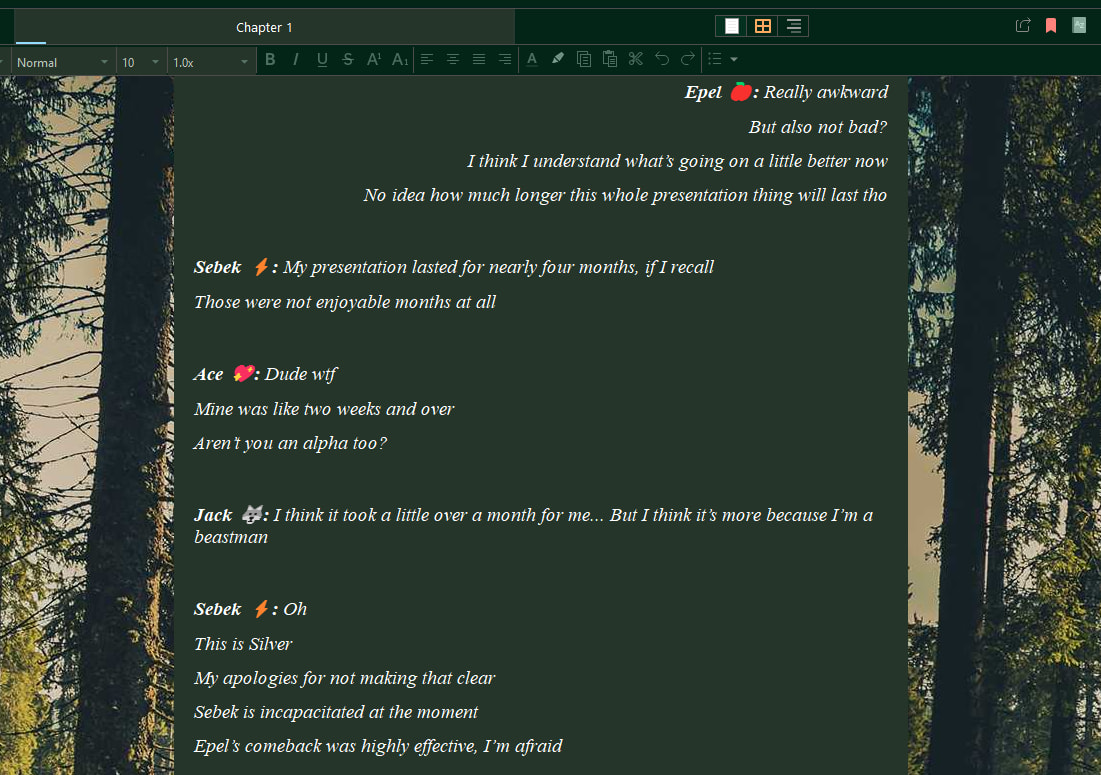
Sorry for being unclear! I usually think of parts of each scene as “sections” in my head. It happens when it’s a larger chunk of text, yes. I don’t use scrivenings mode as it simply doesn’t suit my needs. I also prefer my chapters to be contained in a single document, regardless of length (some go up to 5k, others get closer to 20k, but most stay in the 10k range). The latest I finished working on always reopens at this spot:
Every time there is a third style in use, that’s where the document reopens. And if there are multiple scenes like this (in this chapter there are three separate message exchanges), it always opens in the latest one. There are also around a thousand words after this passage (some of them are styled as text messages, but a good chunk is more normal text).
The cursor issue also happens when I only use the default no style, but then the spot where it reopens is a little more random (not always the same line, but still usually around two pages above the end of the document).
Thank you for this detailed post, that makes a lot more sense to me now.
Unfortunately that does mean that I was essentially already testing the conditions that you’re spotting this under, but without any issues. It always loads to the cursor position (usually at the very top), right where I left it. I’ve been setting a purple highlight in the text to the left or right of the cursor, so I can verify for sure it isn’t drifting.
Since it seems like you have a very solidly reproducible case, would you mind sharing enough of this project with tech support, so we can try to get it to happen on our end?
This may or may not be related, or may simply be an intended behavior that I am unaware as I am new to the software, but I note this same behavior happens when I use ‘View - Text Editing - Page View’
However, none of the work-arounds provided in this thread work as the cursor simply isn’t in the document anymore when changing back to the document using show the previous/next document arrows. The only way to return to my previous position in this case is to either fully highlight a selection of text before changing documents and using the return to selection command, or to simply scroll back and click into the document.
For now, I’m simply not using Page View anymore, but I would be surprised to learn that this is intended behavior for the mode.
Quite right, Page View doesn’t support scrolling to the cursor on load. It’s not quite related to the above, which seems to depend upon scrivenings mode (which is incompatible with page view), but it is certainly topical enough to cluster together. I don’t know if that’s a technical limitation or an oversight though. I’ll check.
Sadly that’s true of all navigation in all modes in the Windows version. It has no memory of where the focus was when using any method of changing items. However the cursor position and selection is saved and restored, even in Page View. You therefore have to get the focus back into the editor without disturbing the cursor (i.e. not clicking). Here is a recent thread on how to do that, and how to customise the shortcut.
But yeah, not using Page View also works. But it’s good to know the above trick anyway, if you do prefer keyboard to mouse navigation.
Ah, that’s very good to know and understand, thank you for information!
That navigation method definitely works, though it’s not ideal for my workflow and I imagine I’ll just use page view intermittently when I want to get a gauge of things. A minor hiccup, all things considered.
After literally years of being aggravated by this bug, I found this thread (by an ai linking me to it). It took me a while to make sense of the thread, so I’d like to add a summary here at the current end for the next confused wanderer:
AmberV’s note of Dec 2022 points to the menu Edit ▸ Find ▸ Jump to Selection but doesn’t mention the standard hot key Ctrl + j. So, here’s my contribution at the end: hit Ctrl + j when coming back to the page and hope the next update has fixed this annoying quirk of an otherwise great product.

 This doesn’t seem to be a very common bug, so any data we can gather on it the better.