No, it wouldn’t be like that at all. It would be like saying: “I think I’m no good at coming up with ideas so I’ll crowd source them and then not give credit to the individuals in the crowd who actually did that thinking that I’m pretending was generated by a machine.”
Strawman.
Of course not. Schrader has in the past turned down big money to write sequels and to make changes to his projects that he did not agree with.
Honestly @pigfender I thought you were better than this. How disappointing.
Neither a quill nor Scrivener claims to be able to actually come up with the words for you.
4 Likes
Wow, passive-agressive much?
So without knowing anything about my process, you’re ready to cast aspersions on me, and presume to know my inner monologue?
Also, pretty ignorant take on LLMs, but kind of consistent with your comments on the subject. Often wrong, never in doubt.
It would be nice if we could discuss this important and game-changing subject without resorting to ad hominem attacks.
Deliberately misunderstanding an analogy or metaphor because you can’t refute the argument is pretty weak beer.
Also, Scrivener’s Name Generator “actually comes up with the words for you,” and they’re pretty significant words – the names of your characters.
Your prejudice against LLMs and other kinds of Machine Learning obviously runs very deep.
It’s a shame that it makes the forum less user-friendly.
We’re all fucked in the long run. Whether one uses the “tool” or not is irrelevant (as currently is this conversation), since anyone, dumb as hell or not, has access.
No need to fight over it. 
3 Likes
At the same time, it will empower those who couldn’t face the process of writing. Non-writers will be able to make an enormous number of mediocre, machine-written books. As this becomes easier and the quality increases, we will be engulfed in a tidal wave of poorly conceived and executed books. Publishing will never be the same.
I’ve also noticed that in many creative domains, the two groups that are he most excited about the promise of Machine Learning are (1) non-creative sellers of creative works, who can use ML to create works without having to engage (or share money) with pesky creatives, and (2) aspiring creatives who couldn’t muster the whatever to create something themselves, and now they can take the smallest shred of an idea and have ML flesh it out.
Both these groups share another quality: because they have not trained and toiled in the creative domain, they generally do not know the craft, and have not developed the taste to know good from bad work. The result is that they praise ML creations excessively, because they can’t tell that it’s not very good. Only when the audience doesn’t respond strongly to the product do they get a sense that something is wrong. This is equally true in image-making and filmmaking.
1 Like
It sounds like we agree, then.
About that, at least. I think we differ fundamentally about the lack of utility. IMHO, just because many people misuse a tool or technology, doesn’t mean it isn’t useful in some other way.
I find ML and LLMs to be profoundly useful and helpful, but I enjoy writing pages so much that I’d never want to give that up. So I use it for other things.
2 Likes
Could you explain what you mean by Grammerly adding a layer?
If you make someone’s character part of your argument, you can’t complain when the other side then shows the person’s character isn’t what you’ve presented it to be.
Are you really disappointed in me for not being comfortable with what Paul is accused of?!
There was nothing passive about it! Sorry about that. I actually wasn’t thinking of you when I wrote that, but sticking with Paul, but I can see why it came across like that.
What I will say, though, is that this is exactly how I view using AI. It’s theft that undervalues your artform and rights.
Sigh. Okay, here’s the problem. We’re both 100% correct. We just have different priorities. You are absolutely correct that not using AI will leave people behind. I just think that’s not a good enough reason to support or use it. That may well make me the fool you talked about.
AI has some uses, none of which are as good as people say, and none of which are worth it (in my opinion).
2 Likes
I’m amazed I have to explain this to you.
It was implied by another poster that since they don’t like the product of LLMs, that Schrader must be corrupt and bought off to express this opinion. I pointed out that Schrader has a well-known reputation for standing on principle when it comes to his beliefs and opinons. His sexual behavior has nothing to do with it.
Again, I give you credit for a certain level of intelligence, so it’s disappointing to see you stooping do deliberate misunderstanding in order to bolster a weak argument. That’s what I’m disappointed with – that someone obviously bright and capable pretending to be less so in order to try to distract from the weakness of a line of argumentation.
We disagree on that. I’m not convinced that there exists an authorial right to prevent someone from measuring the relationships between words in my book or screenplay.
I strongly recommend that all writers get familiar with LLM tools, and find how to make use of them in a way that suits their style of working. Getting angry won’t make it go away. Neither will hiding. This is the new normal. Time to play the cards you’ve been dealt.
Not quite in the spirit of the forum?
Yes, I got that; it’s not rocket surgery. However, when your argument relies on and raises the good principles and character of your “witness”, you open your “witness” to character review.
I get that not everyone is a trained lawyer, but you’ve probably seen a legal drama at some point.
Now who’s being passive-aggressive! 
Thank you, I suppose. I give you credit for a similarly certain level of experience in this field.
I understand, I just think you’re undermining your position heavily by deputising the character and judgment of someone who allegedly has issues with both of those. I take those issues seriously, and make no apologies for doing so.
Sadly, you are probably right. That doesn’t mean it’s not a sign of character to “get angry” (I’m not sure I’d say I’m getting angry — you might be imagining ALL CAPS where there are none — but I take the point) in face of things you think are morally questionable.
Both statements are predicated on the expectation that the other poster is a bright, sophisticated person who usually mounts an excellent argument.
Plus, they started it. 
1 Like
‘but dad - he started it’
I grew out of that one before 10.

1 Like
I think you’re painting with a very broad brush. Just because Schrader doesn’t know how to comport himself around women doesn’t make him a less capable writer, or a less capable judge of a movie idea specifically tailored to him. Schrader is also a salty old f*ck who doesn’t suffer fools, and if he didn’t think the ideas from ChatGPT were any good, he wouldn’t mince words.
If that’s any consolation: Humanity has never been able to clarify whether a “good person” who has also done “bad things” in his life is a good or a bad person. What can be compensated for by what? Can or should you separate one from the other? There will never be agreement on this. That’s why I’ll spare you my opinion.
Edit: Ah, this is of course a moral consideration. Legally, the matter is clear, at least where I come from.
Grammarly adds more than a single layer to your work.
Firstly, it monitors your writing and pops a bubble listing a number of suggested changes, be they spelling or language errors or sentence structures or whatever else it’s programmed to do.
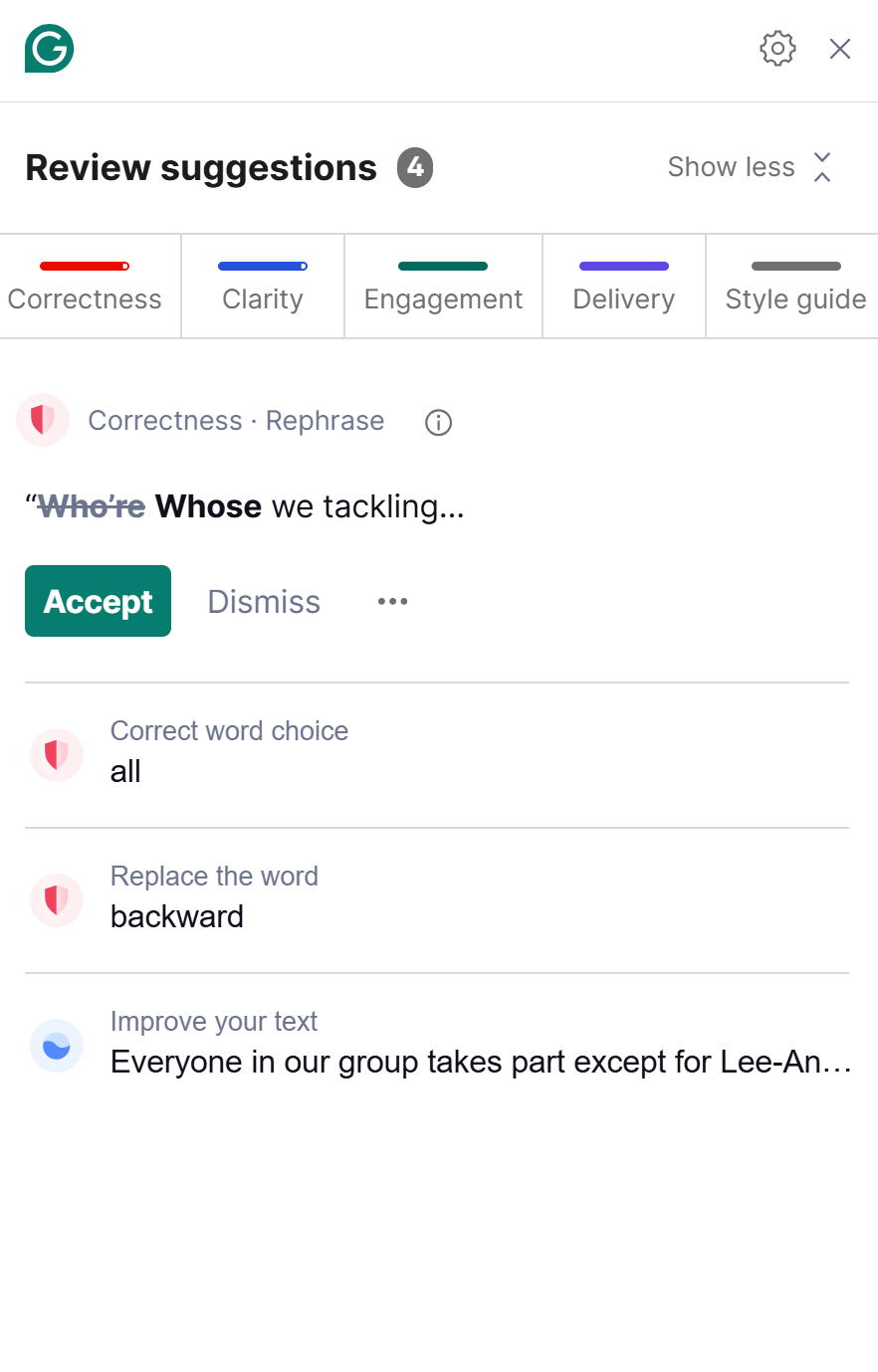
Clicking on the bubble, it lists what it’s referring to, which you can choose to deal with by clicking on each sequential item or handle it directly in the Scrivener editor and other text-based areas according to what Grammarly colour codes as areas for attention. If a user finds this too daunting, they can switch Grammarly off in any app, including Scrivener for an hour or permanently until you unblock an app in Grammarly’s settings.
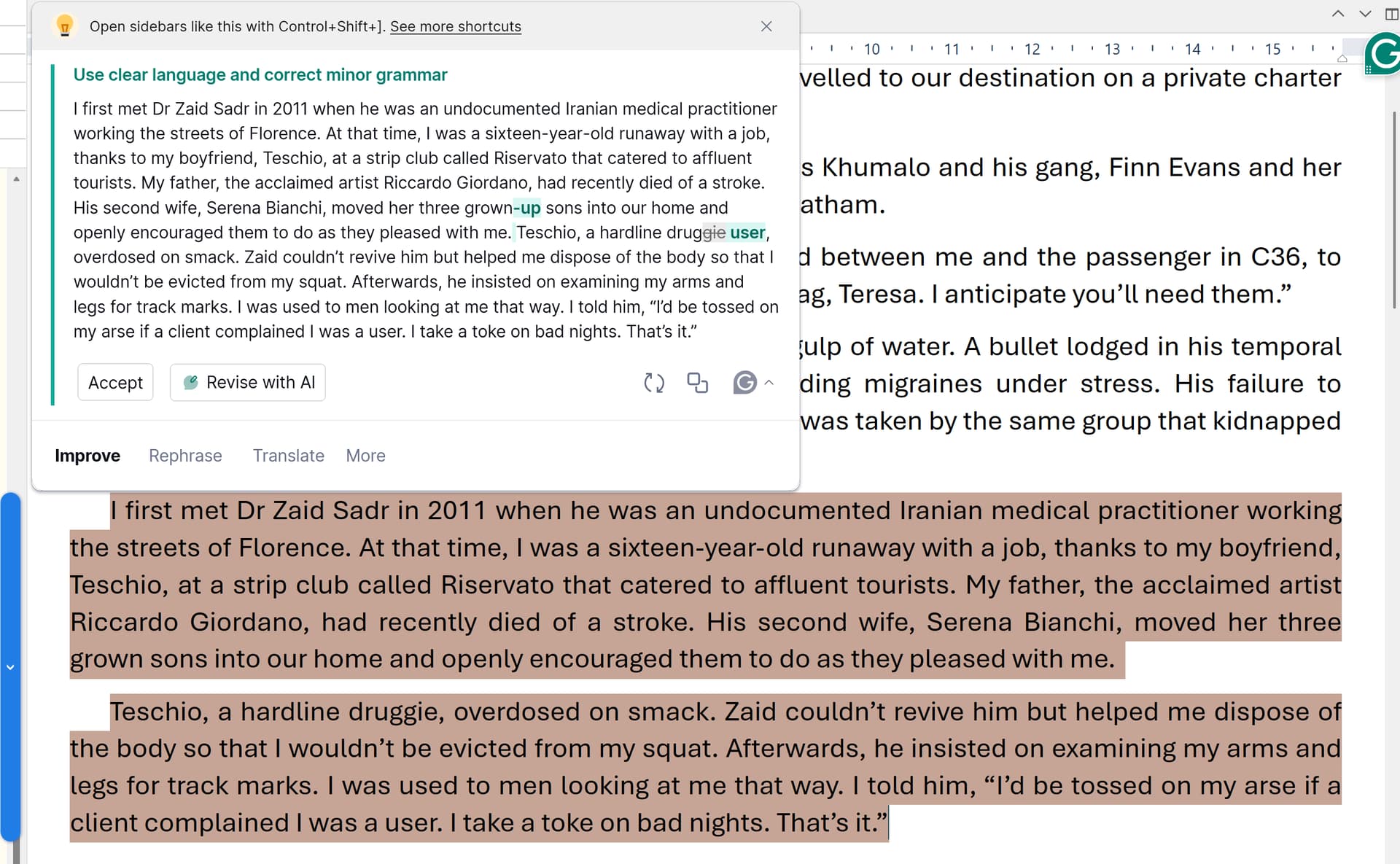
Furthermore, by highlighting text in an app like Scrivener, a blue bar appears to in the left margin, and clicking on it suggests alternative ways to write a piece that is intrinsically correct.
A new feature Grammarly is beta testing is called Authorship. For this a little unintrusive fingerprint floats towards the bottom left of whatever is you’re editing. Its purpose is to assist in proving where your words come from by recording what you type and which sources you use. You choose how to share your information.
Grammarly also has a check for plagiarism feature.
Any of the additional mentioned features can be switched off by default in Grammarly settings.
Grammarly can also open Scrivener projects, where Grammarly becomes your editor, but then you lose touch with the rest of Scrivener’s utilities at your fingertips.
I am deeply skeptical about AI’s impact on the arts, something I predicted in a university physics paper in the seventies on my idea of creating a computing device based on quantum particles–which, by the way, is where AI is heading. Buckle up.
Anyway, I have a question for you. I’m writing a fantasy novel series. I wanted to determine where the moon would be in the night sky on a certain date/time on the west coast of Scotland. In the past, I would figure this kind of thing out mathematically, using data I could find online. But this time around, I simply asked CoPilot and got my answer in seconds. There was almost no interruption of my creative flow in writing that scene, and I was happy about that.
Here is how I used that in the scene:
Still half-asleep, it slowly dawned on him that the rapping wasn’t coming from the door, but from outside! He padded to the window, where cold, silvery light poured in from the nearly full moon hanging low in the western sky.
Do you think my use of AI in this instance was worth it?