The Psychology of "Very" Small

I wanted to write “tiny” instead of “Very Small” but that seemed a bit off.


Okay, so what’s this idiot into now, you may be asking yourself?


Well, I have this weird thought process that using a small screen to view what you write can start to affect your style. Sort of cause you to be stifled. Sort of cause you to think small.

Ever read or hear about some writers that go out into a field (flat Earth surface) to sort of broaden their scope of creativity?

Myself, I find that when I use this work station where I have this kind of large monitor and this keyboard I can do better writing than when I send SMS to family or use that txt format for miscellaneous notes.

Just wondering, folks. Just wondering. ___ And wandering, too.

In fact, there is one thought that is more specific, less into wandering.

When I am composing a super long SMS to a family member, I can’t see a lot of the previous bit of writing without scrolling. And that scrolling can interfere with a chain of thought.

I’ve noticed that with notes in the ‘Notepad’ section of the Android unit.

With this monitor I can go quite some way into a piece of writing before having to scroll up to an earlier paragraph. And usually, the creative links are paragraph to paragraph and so to keep a chain of thought going one need only glance up to the previous paragraph, not lose a train of thought, and complete a given thought process.

But on my Android unit a long paragraph disappears rather quickly, no matter if it is the email program, the ‘Notepad’ program, or the SMS.

AND; yes, I know there is the tech stuff that allows my wonderful Andy to show me all my writing stuff on the ‘big brother’ monitor if I set that up. But then there is that keyboard problem.

I like my fingers doing stuff that my brain may have not thought of yet. Sometimes my fingers type stuff the brain hadn’t anticipated and some of that comes out rather not so bad. BUT, that sure doesn’t happen much with the ‘very small’ Google toy. In fact, I use a touch screen pencil as my big fingers can’t handle those tiny keyboards.

Do any of you find your work is better if you use a “normal” computer and monitor?

I mean, other than that ancient method of paper/pen.
1 Like

I’ll leave it to you and others to work out whether writing on a small screen versus an expansive one changes one’s writing. I do find it an interesting question, though.

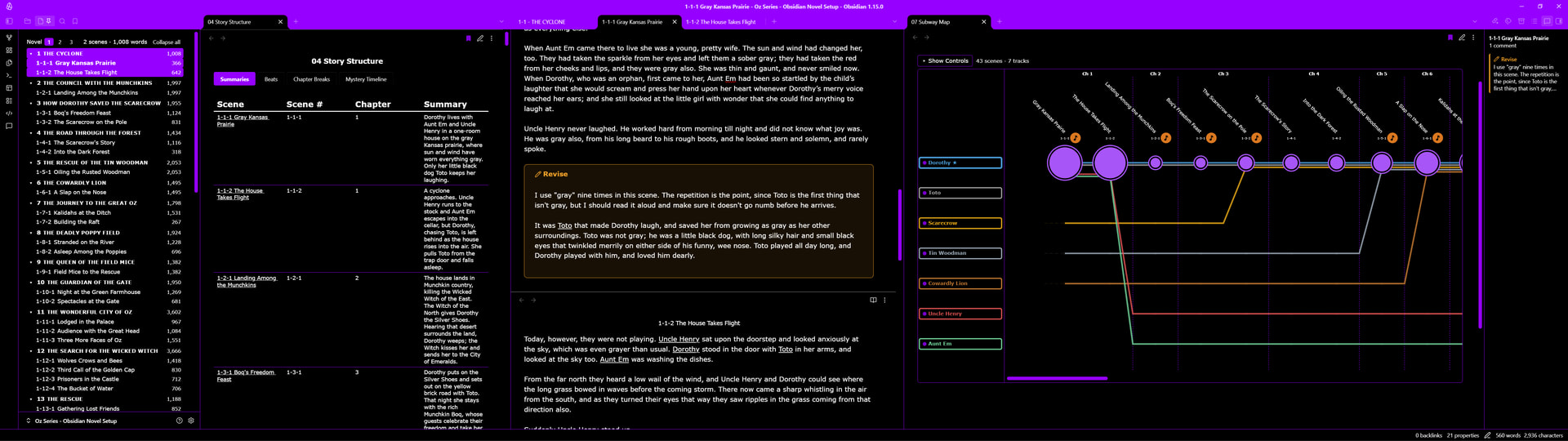
All I can contribute is my own strong preference for an expansive screen, particularly when writing fiction. I’ve created my own customized writing app with Obsidian as the foundation, which takes advantage of my screen real estate.

This is how L. Frank Baum, author of the Wizard of Oz series of novels, might have used my writing system, had he been writing them today:

Do I think an expansive imagination can be defeated by a tiny screen? No. But can an expansive imagination be fed by an expansive screen? For me, yes.

I’d say it very much depends on the stage of the project. I’ve written first drafts on literal 3x5 inch index cards. Once I’m into the editing stage, though, I need a lot more room.

2 Likes

What you use to write and how you do it will always have an effect.

Prachett used six big monitors.
Gaiman used fountain pens and notepads.
George RR Martin uses an ancient word processor.
Barbara Cartland dictated over six thousand words a day (length approx two and a half hours)

I can use anything.
For writing, I have a strong preference for a simple no-distraction pane of the appropriate size for the final destination (I like articles to have that length of line, books to have book line length etc - I consider the white space as much as the text and the words).
I dislike writing on phones. I’m fussy about keyboards.
But I’m not fussed about screen size per se.
Except when I’m not doing pure writing - because then I may want a host of other things available on screen; more screen space is convenient when there are many things I might want to see.

1 Like

Making note of that dictation style; I’ve tried using some unit’s dictation system and I really couldn’t get my brain to operate the same as simply typing.

I write “some unit’s” because I have a number of different units in two locations and I really don’t remember which one finally allowed me to try it. I remember I had to yak at the unit about three times so it could recognize my speech, or some such thing, and I got so frustrated that I waited for a number of hours before actually trying to do some work.

But the finger magic just wasn’t there. When I let my fingers go nutso I can sometimes create good stuff. PLUS, there is the benefit of blaming my fingers if it all reads as awful when finished.

And that mention of a “word processor” sure brings back a few memories.

In fact, this post is reminding me of that clunky typewriter I used to use before the things got electric and stuff. Those old typewriters sure were heavy.

Funny, I also now seem to remember that sometimes a key needed changing. Good gosh, that must be some fifty years or so ago.

And “pen and paper” has always been useful. Still remember the fountain pen and the big trouble if you had the TV on and something you heard made you look over at the TV and you forgot the pen was still touching the paper and you look back and there is a future Picasso-type miniature on that hour-long-work homework paper that was supposed to look beautiful for the professor’s eyes. <><>Dan Rather, you … !!! <><>

1 Like

I learned to type in school on manual typewriters, which of course required a lot more force than electric typewriters or computer keyboards. To this day I’m murder on keyboards because I bang away with far too much force. Just the other day I had to disassemble my keyboard and solder in a replacement switch for the “s” key which, being on the home row, got a particularly enthusiastic beating.

Funny, I also now seem to remember that sometimes a key needed changing. Good gosh, that must be some fifty years or so ago.

I had a Sears electric typewriter where certain keys could be swapped, such as for mathematical symbols. Could that be what you’re thinking of?

No, I was sort of distant remembering something about the big clunky ones and that something about those big and long keys could break. Or something like that. I can’t even remember the name, anymore. And it was there right in front of your face in big letters.

Maybe I better go check GIL for an image.

Oh my!!

Now I remember. That little arm that flew up to type a letter could break. And could be changed.

EDIT: The Wiki has many images I am referring to. And, just in case anyone didn’t see where I offered this in another thread: GIL = Google Instant Library.

Got it. I never managed to actually break one of those things. They were built like tanks, and for good reason.