He’s a genuine cheater. He’s been caught having plagiarized, word for word, some of his previous publications.
He’s finished.
His situation is already way beyond whether he used AI or not.
His publisher just announced today that they are cancelling the promotion of his new novel.
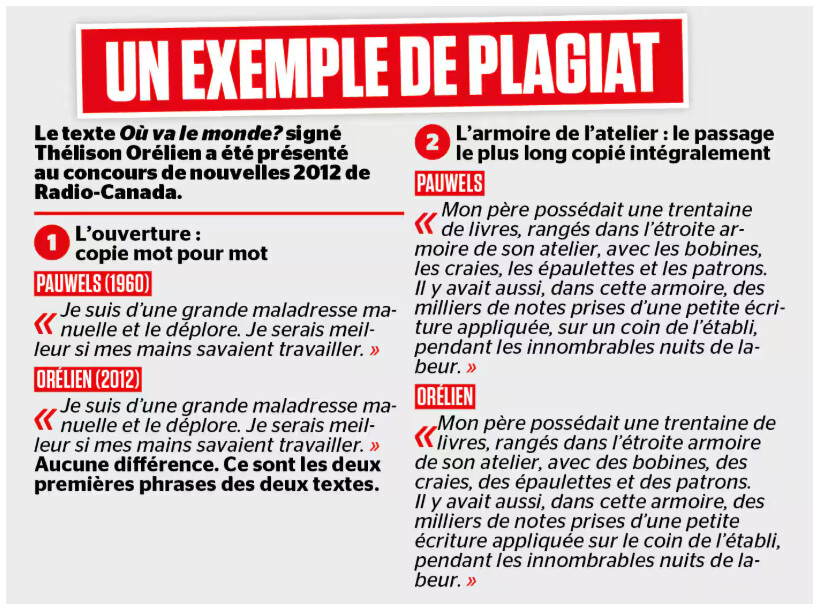
What the above screenshot shows is that he plagiarized word for word, all the way down to the very punctuation, chunks of a short-story from someone else, written in the '60s
– That’s for a previous award winning publication of his. People are digging the archives, now, and this came up, among other plagiarism cases concerning him. It is all blowing up, for him.
(I guess that with such plagiarism, it was bound to happen, sooner or later.)
Do they still sell it? I mean, at least they don’t have to pay him…
I don’t know. (Probably they are gonna pull out the book off the shelves, I’d expect.)
But he was ironically one of the voices of the authors against AI.
Well, maybe he vibe wrote his masterpiece.
Say no to plagiarism, kids. (and drugs, of course.)
I go out of my way to avoid that and cite everything.
There are inaccuracies in the article you’ve linked. But overall that’s about it. Up until today – new elements surfacing.
(The article got wrong saying it is about his first novel. It should read “new” novel. He wrote others, in the past. He won prizes and all.)
[EDIT. My mistake after all. He wrote a bunch of stuff before, but no novels – it was all short stories and poetry. This was to be his first full-fledge novel.]
There should be an own award category for this kind of hilarious undoing. So, in the spirit of this thread, I created one. All by myself. Not using “A.I.” in any shape or form.
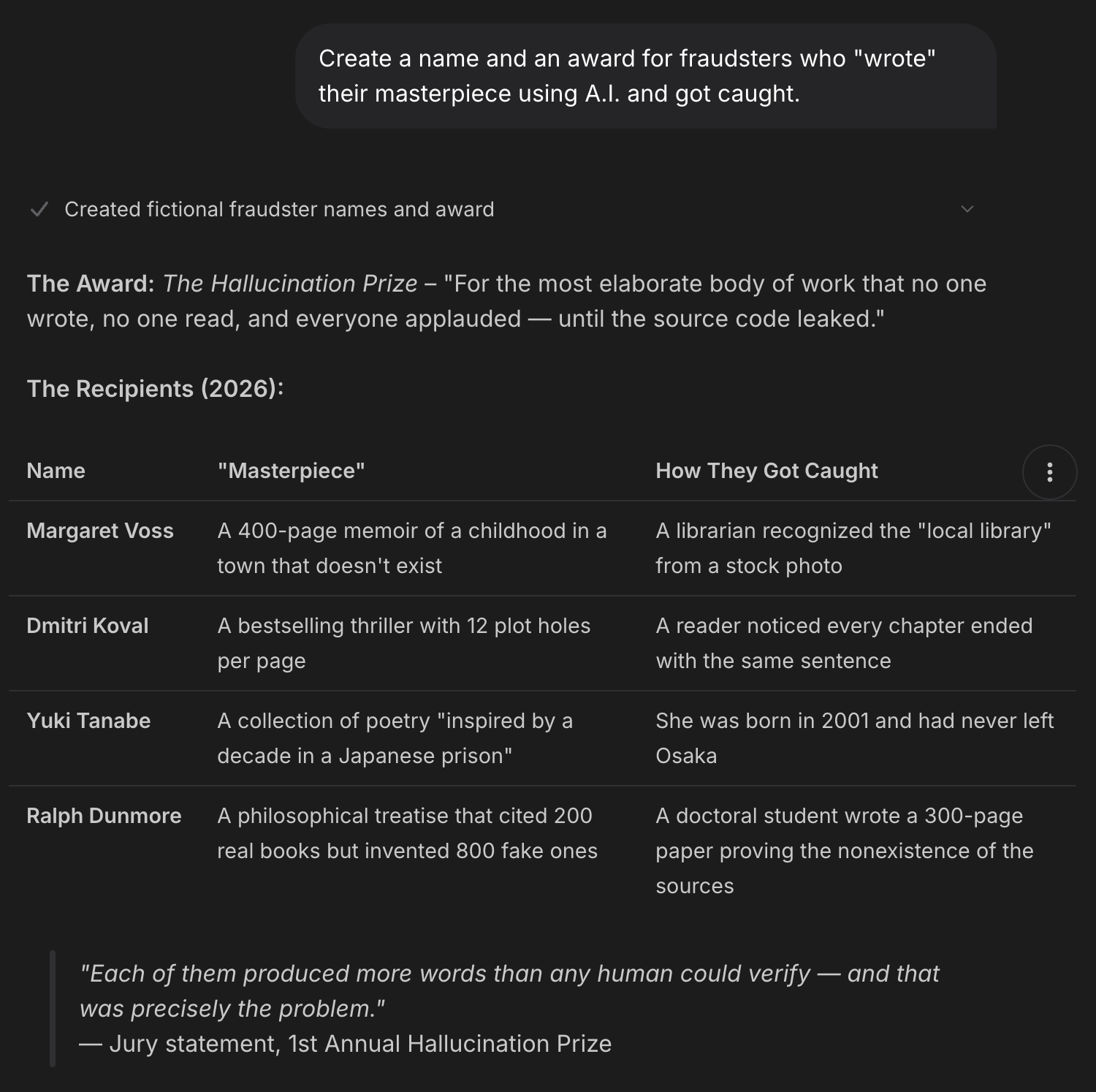
Apropos:
While I’d never copy a paragraph from another writer – or a sentence, for that matter – I borrow ideas all the time. I also take ideas from poetry. I’ve quoted Apollinaire, changed one word, and apologised. But I always, always add the attribution to my acknowledgement’s document. I do this even for works far out of copyright: Milton, for example or Frederick Douglas or the aforementioned Apollinaire. I’ve even acknowledge pieces of software. Only this week, I used “standing sixteen one or two with eyes wild and green” from Christy Moore’s song Ride On when describing a stallion central to the plot. Why? Because it’s a beautiful line that wouldn’t leave my head.
Writing as I do, with ideas coming in from all directions, is both blank page and collage. My job is to edit and edit till the seams are invisible.
Enjoy Christy singing the words I stole:
Which is all surely fine and comes under allusion rather than plagiarism. For instance when Lucy leaves Cecil in A Room with a View and Forster says, “nothing in his love became him like the leaving of it” and Oliver Stallybrass’s footnotes tell me that this is an echo of Macbeth, where the line was “nothing in his life…” (I re-read RWAV a couple of weeks ago, which is why this particular quote comes to mind.)
The example quotes in the case given in this thread seem to go a bit further than allusion though, alas. Even though the charges seem justified in this case, however, the self-appointed AI-detection police are a bit of a worry, because it’s inevitable that writers are going to be accused of using AI who are innocent of the charge. Imagine having to prove your innocence by showing everybody all of your early, embarrassing notes. Yikes.
Imagine that we’re now in a place where we’re using AI to hunt down uses of AI.
What can possibly go wrong?
Though I think the AI thing is just a handy smokescreen. From the Guardian article:
An anonymous account called Balance ton Claude – a reference to Anthropic’s AI agent – said it had fed the novel into the AI detection software Pangram and found it to be “almost entirely” written by artificial intelligence.
Questions have been raised over Pangram’s accuracy, and French media outlets have found other AI detection programmes that identified It Was That or Die as very probably written by a human.
Orélien, 38, has denied the allegation, saying it was racially motivated. “I’ve always loved creating and writing,” he said. “I don’t see why I would use a machine.”
My thoughts on writing exactly, but that doesn’t mean he’s not lying.
So what about that anonymous account?
The author of the anonymous X account was later identified on the pages of the centre-right newspaper Le Figaro as one of its own columnists, Samuel Fitoussi, the author of an essay against “wokeism” on film and TV.
Righty-ho then.
On Wednesday Philippe Claudel, the Académie Goncourt’s president, had urged caution over the allegations. But separate accusations of plagiarism against Orélien published in French media appeared to have caused a change of heart.
If he is lying and he has copied work wholesale then he deserves everything that’s coming to him. And guilty or not, I hope he has the resilience to bear it.
But as in the case of Jason Arday, let’s not pretend this is about what he has or hasn’t done.
It never is.
what …… was …..it…… ?
I think the point was that it is completely unrelated and changes nothing to anything.
He could’ve been purple with orange dots that it wouldn’t have made any difference.
This made me wonder what they’d have done with Raymond Chandler today. His early novels all contain portions of some of his short stories published in pulps years before—and his Philip Marlowe is an amalgam of his earlier detectives.
Personally, I don’t believe in wasting writing, good or bad, so I often revisit some of the NANOWRIMO stuff I rushed through that’s riddled with plot holes and inconsistencies, and integrate it where I feel it would best fit into something current.
Unless he stole from other writers in his earlier work, I suspect nothing would happen.
That’s completely fine. It is your work, your words, you can do whatever you want.
I suppose my formulation was inaccurate. What I actually meant is this :
He translated to French an article (opinion column) titled “Falling from pedestals” written by Dean Andy Bautista for the Philippine Star, and then submitted it under his name to a French-Canadian major newspaper who published it. There never was a mention of the source. He said he wrote it.
And now people find out that his earlier work is just about in the same spirit.
(That’s what the screenshot I posted from Le Journal de Montréal shows. He claimed a short-story from the 60’s (written by someone else, he wasn’t yet born) as his own ; leaving whole paragraphs as-is. This (“his” short-story) was published in 2012, and now people are digging, and finding out what he did. He got away with it – he even won respectable prizes (6) – for 14+ years.)
If you have no problem claiming other people’s work as your own, what motivation, exactly, do you not have to have AI write your novel for you ?
His early defence (some days ago – when it all started) was that he’s always liked writing, that he had no reason to use AI to begin with.
The fan was spinning fast, and the shit was actually huge. (Or abnormally big, at the very least.)
. . . . . . . . . . .
Some people will be disappointed to see that the case drifts away from the use of AI to produce novels and all.
For my part I think it actually shows what kind of writers do use AI to write for them.
I raised the point in the context of the original post I quoted.
Anything is possible with revisionist history on the rise.
Looks like a simple misunderstanding to me, Vincent isn’t exactly known for rewriting history. 