I love Lord of the Rings and related works in the Legendarium. It amazes me how much it was a labor of love that spanned decades. And I have a deep respect and appreciation for his son Christopher, who studied all the drafts and scraps of paper to piece together the history of Middle-earth.
The thought occurred to me how marvelous it would be to see a mock-up of the LotR as a work-in-progress in Scrivener!
“And it had to be typed, and re-typed: by me; the cost of professional typing by the ten-fingered was beyond my means.” (J.R.R.T.)
I think copy and paste (or any method of simple text duplication) alone would have blown him away. Add Scrivener to this, and likely Aeon Timeline, fonts for all of his invented languages…
Lots of additional free time to answer e-mails. Or running a weekly vlog, sitting in the woods blowing vape rings.
When I first started using Scrivener all I can think of was how Tolkien would have used it. Can you imagine the custom metadata? The synopses and notes? Snapshots?
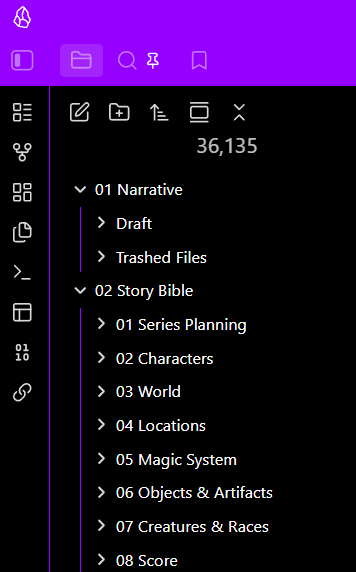
I’m in year four of my seven-novel fantasy series (I’m slow, for sure), having just this week completed the first draft of novel 1. My story bible, which I maintain in Obsidian, has 245 reference entries, and that doesn’t include the metadata tracked by Scrivener in sync with Aeon Timeline. I think Tolkien would have loved Scrivener, Aeon Timeline, and Obsidian as much as I do.
The Narrative folder is the Scrivener sync folder. Scrivener exports each document as a plain text file, and Obsidian reads those files directly. If I want to, I can write or revise a scene in Obsidian and let Scrivener pull the changes back in on the next sync. I tend to do this when I’m traveling with my laptop because it’s simpler to open Obsidian, which I sync through OneDrive, and just write. Scrivener works fine on the road, to be sure, but for quick drafting sessions Obsidian feels lighter. Most of the time, though, I’m writing at my desk in Scrivener.
A limitation worth mentioning
One limitation is that Scrivener Sync does not convert its rich text to Markdown when syncing to the sync folder and does not convert Markdown to rich text when pulling the plain text back into Scrivener. Here’s a thread I started today on this: Sync Folder: A question about the round trip with Markdown. My workaround, which I implemented today, actually, is to just use Markdown when writing in Scrivener for italicized words and the like. Mostly I through asterisks around words I want italicized; it’s simple enough that it doesn’t slow me down in the least.
Having the narrative available as plain text is also useful for automation. Python scripts can work on those files safely, which I would never attempt to do within Scrivener’s internal project structure. Tasks that would be comparatively tedious (at least, at my current level of familiarity with Scrivener) to manage inside Scrivener become straightforward when the text is exposed in a normal folder.
The Story Bible lives in the same vault but does not sync to Scrivener. This is by choice since I could, if I wanted to, sync the story bible files to Scrivener as, say, Notes.
It’s intriguing to imagine what Tolkien would have thought about all this!
Pandoc can convert RTF>MD>RTF; is there a way you could automate it with a bit of javascript and folder triggers? I’m on a Mac, and I could do this using built-in applescript or a macro app called Keyboard Maestro. I don’t know Windows well enough to work out the particulars.
I’ve thought about this, too, but, though I can imagine a script to make something like this work, I don’t know enough about Pandoc and how it interacts with Scrivener. Let me give this some thought…
But for me, the interesting thing to think about is how using Scrivener would have changed his books, because it would have.
When I was a typographer and later editor at a trade book publisher in the early to late 80s, we saw manuscripts change as the decade went on and more and more writers purchased PCs to do their writing. The most obvious difference was that manuscripts got a lot longer, but there were other, more subtle differences that I can’t really remember right now.
Tolkien mavens should weigh in here on how he wrote the books, but I suspect that writing 20 pages longhand or with two-finger typing really changes how you think about what you are writing.
“This is why I like writing my stories and novels on index cards, numbering them later when the whole set is complete. Every card is rewritten many times. About three cards make one typewritten page, and when finally I feel that the conceived picture has been copied by me as faithfully as physically possible – a few vacant lots always remain, alas – then I dictate the novel to my wife who types it out in triplicate.”
– Vladimir Nabokov
Alas (from me) I suspect he might have continued by hand even with the wonderful Scrivener program available to him. But perhaps Vera . . .
 Snapshots?