I wrote about this very thing in the thread Scrivener, Obsidian, and Aeon Timeline…Oh My! but here’s the short version of how I use Obsidian alongside Scrivener.
My Obsidian vault holds two major parts of my series: the Narrative folder (01 Narrative) and the Story Bible (02 Story Bible).
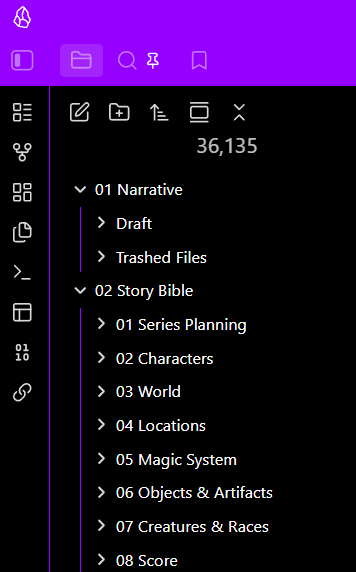
The Narrative folder is the Scrivener sync folder. Scrivener exports each document as a plain text file, and Obsidian reads those files directly. If I want to, I can write or revise a scene in Obsidian and let Scrivener pull the changes back in on the next sync. I tend to do this when I’m traveling with my laptop because it’s simpler to open Obsidian, which I sync through OneDrive, and just write. Scrivener works fine on the road, to be sure, but for quick drafting sessions Obsidian feels lighter. Most of the time, though, I’m writing at my desk in Scrivener.
A limitation worth mentioning
One limitation is that Scrivener Sync does not convert its rich text to Markdown when syncing to the sync folder and does not convert Markdown to rich text when pulling the plain text back into Scrivener. Here’s a thread I started today on this: Sync Folder: A question about the round trip with Markdown. My workaround, which I implemented today, actually, is to just use Markdown when writing in Scrivener for italicized words and the like. Mostly I through asterisks around words I want italicized; it’s simple enough that it doesn’t slow me down in the least.
Having the narrative available as plain text is also useful for automation. Python scripts can work on those files safely, which I would never attempt to do within Scrivener’s internal project structure. Tasks that would be comparatively tedious (at least, at my current level of familiarity with Scrivener) to manage inside Scrivener become straightforward when the text is exposed in a normal folder.
The Story Bible lives in the same vault but does not sync to Scrivener. This is by choice since I could, if I wanted to, sync the story bible files to Scrivener as, say, Notes.
It’s intriguing to imagine what Tolkien would have thought about all this!